STM32F4 vs F1: Getting to Know the Cortex-M4 DSP Powerhouse
Introduction: The Turbocharged Microcontroller
Welcome to the first step into the world of STM32F4. Moving beyond thick datasheets, this article aims to provide a foundational understanding of why we choose this chip and how its “brain”—the ARM Cortex-M4—outperforms its predecessor, the Cortex-M3 (found in the ubiquitous STM32F1 series).
Level: ⭐ Beginner to Intermediate Read Time: ~10 Minutes
If we compare the STM32F1 (Cortex-M3) to a reliable sedan that handles everyday driving perfectly, the STM32F4 (Cortex-M4) is that same sedan but “turbocharged” and fitted with a “performance-tuned ECU.”
The basic infrastructure and driving experience (programming model) are very similar. However, when you need to step on the gas to overtake (perform complex mathematical calculations), the F4 leaves the F1 in the dust. Let’s explore what that “turbo” actually is.
Architecture Deep Dive
The Shared Foundation: Harvard Architecture
Both Cortex-M3 and M4 utilize the Harvard Architecture, distinguishing them from standard computers (Von Neumann) in key ways:
- Separate “Express Lanes”: There are distinct physical buses for Instructions (code) and Data (variables, memory). This allows the CPU to fetch an instruction and load data simultaneously in a single clock cycle, without waiting in a shared queue.
- 3-Stage Pipeline: They operate using an efficient Fetch -> Decode -> Execute pipeline, ensuring smooth processing flow.
The Vital Difference: What does M4 have that M3 misses?
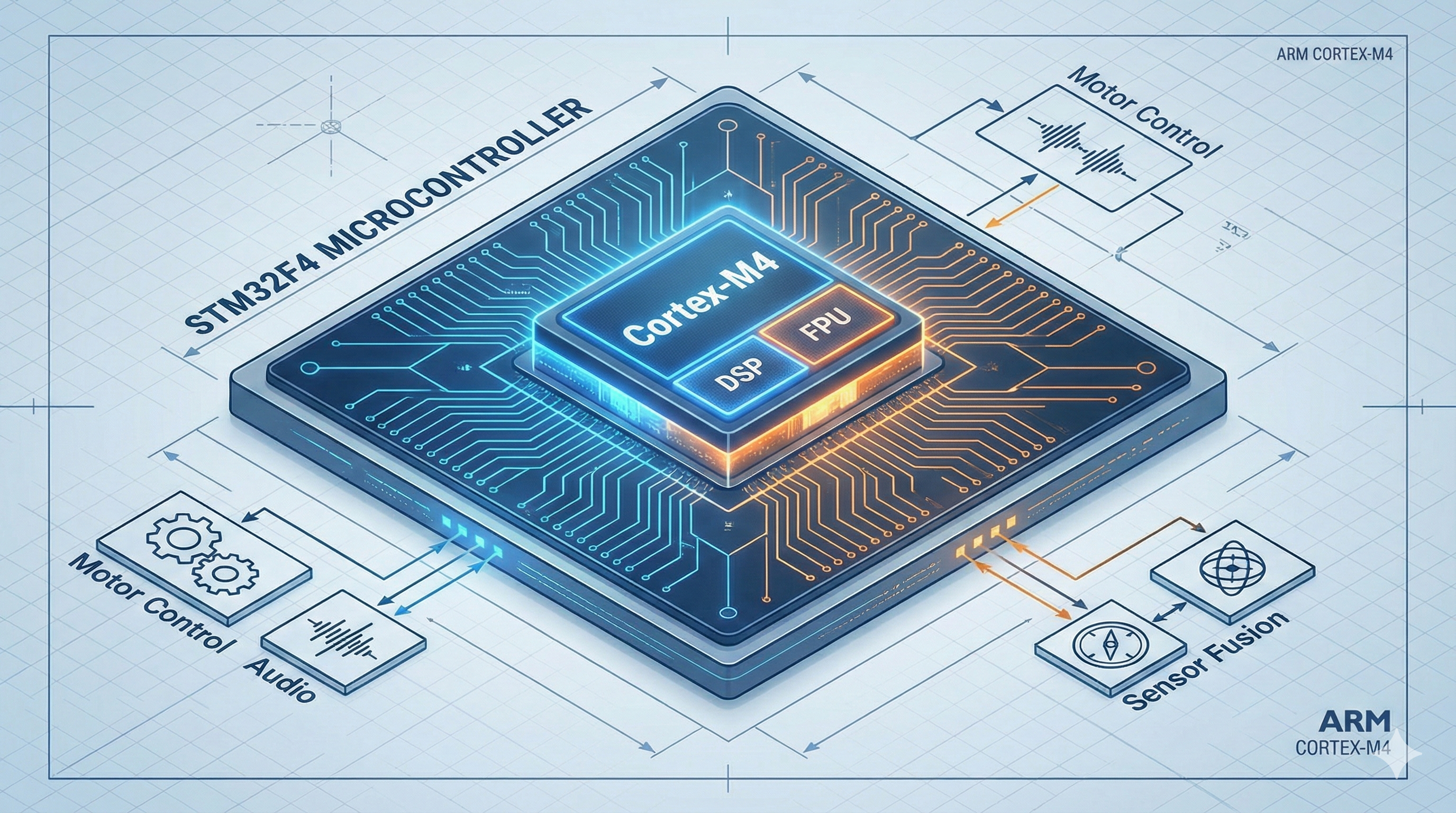
The Cortex-M4 was designed as a “Digital Signal Controller.” It combines the ease of use of a microcontroller with the computational power of a DSP (Digital Signal Processor).
| Feature | Cortex-M3 (STM32F1) | Cortex-M4 (STM32F4) | Real-World Benefit |
|---|---|---|---|
| Instruction Set | Thumb-2 | Thumb-2 + DSP + SIMD | F4 executes signal processing code (Filters, Audio) significantly faster. |
| Floating Point | Software (Slow) | Hardware FPU (Fast) | F4 calculates decimals (float) in 1-3 cycles without bogging down the CPU. |
| MAC Instruction | 32-bit result | Single Cycle MAC | Essential for Digital Filters (multiply-and-accumulate operations). |
| Performance | ~1.25 DMIPS/MHz | ~1.25 DMIPS/MHz | Note: While per-MHz efficiency is similar, F4 typically runs at much higher clock speeds (e.g., 168MHz vs 72MHz). |
Key Features Highlights
1. FPU: The Floating Point Unit (The Hero)
This is the game-changer. In a Cortex-M3, if you write code like float a = 3.14 * 2.5;, the compiler must translate this into a large set of instructions to simulate decimal multiplication using software libraries, consuming many CPU cycles.
The STM32F4 includes a dedicated Hardware FPU (Single Precision). Decimal multiplication takes merely 1-3 cycles, almost as fast as integer math.
Critical Note: You must explicitly enable the FPU in your compiler settings or IDE (usually a flag like
-mfloat-abi=hardor selecting an “FPU enabled” build configuration), otherwise it won’t be utilized.
2. DSP Instructions & SIMD
SIMD (Single Instruction Multiple Data) is the ability to “order once, get multiple jobs done.”
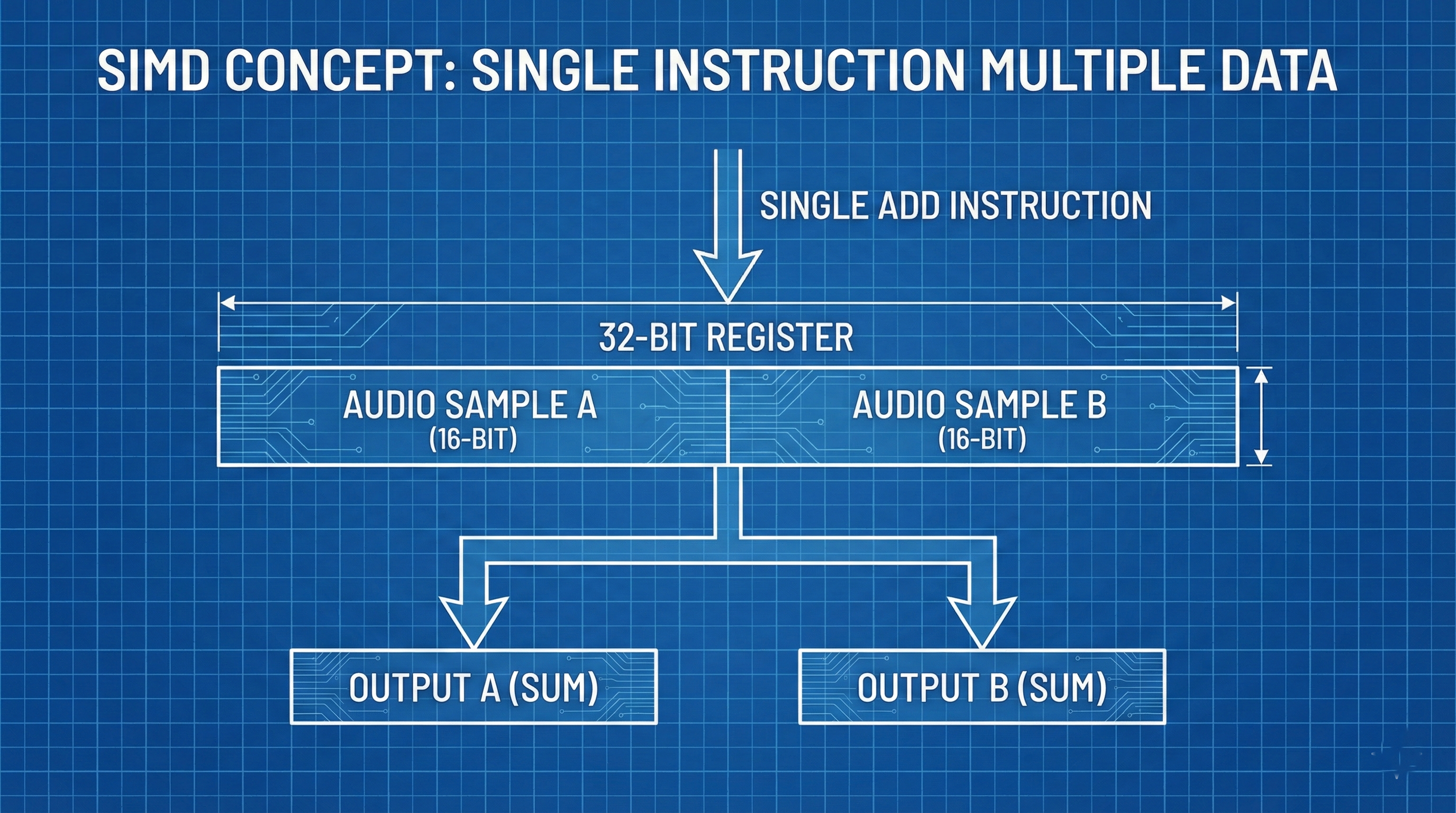 Diagram showing SIMD operation: Single instruction processes two 16-bit audio samples at once
Scenario: Imagine you are building an audio system. Audio data often comes in 16-bit samples, but our CPU is 32-bit wide.
- Cortex-M3: Must load audio sample #1, add it. Then load sample #2, and add it. (Two separate operations).
- Cortex-M4: Can use SIMD instructions to pack two 16-bit samples into a single 32-bit register simultaneously. A single “add” instruction then processes both values at once. You’ve just halved your processing time for that operation.
Conclusion
If your application involves basic tasks like toggling LEDs, reading simple switches, or standard UART communication, the Cortex-M3 (F1 series) is perfectly adequate.
However, if your challenge involves:
- Motor Control: Calculating complex PID loops requiring frequent decimal math.
- Audio Processing: Implementing equalizers, FFTs, or digital filters.
- Sensor Fusion: Reading IMU data (Gyro/Accel) to compute angles using algorithms like Kalman Filters.
Then the STM32F4 (Cortex-M4) is the definitive answer. It was born to crunch complex mathematics efficiently.
Technical References:
- STM32F4 Datasheet & Reference Manual
- ARM Cortex-M4 Technical Reference Manual