The Spirit of C: Why It's Fast, Powerful, and Dangerous

The Spirit of C: Why It’s Fast, Powerful, and Dangerous
Hello everyone! Welcome to a crucial theory session that directly impacts your practical coding. Today, we aren’t discussing syntax; we are discussing the “soul” of the language—the philosophy known as “The Spirit of C”.
According to the introduction of the book Effective C, this language was developed in the 1970s specifically as a “System Programming Language.” It was engineered for raw performance and direct hardware access. These fundamental goals shaped the five core principles that define C today.
Difficulty Level: ⭐⭐ (Essential theory for writing safe embedded code) Reading Time: 10 Minutes
1. Introduction: The Agreement
Have you ever wondered why C allows you to write code that can easily crash your program? Or why it lacks the extensive error-checking hand-holding found in modern languages like Python or Rust?
The answer lies in “The Spirit of C”.
It is essentially an unwritten agreement between the language designers and you, the programmer. C was built for fundamental system work (like operating systems and drivers) where maximum speed and direct hardware manipulation are non-negotiable. This makes C unique, powerful, and unforgiving.
2. The 5 Iron Rules of the Spirit of C
Based on Effective C, here are the foundational principles that govern the language:
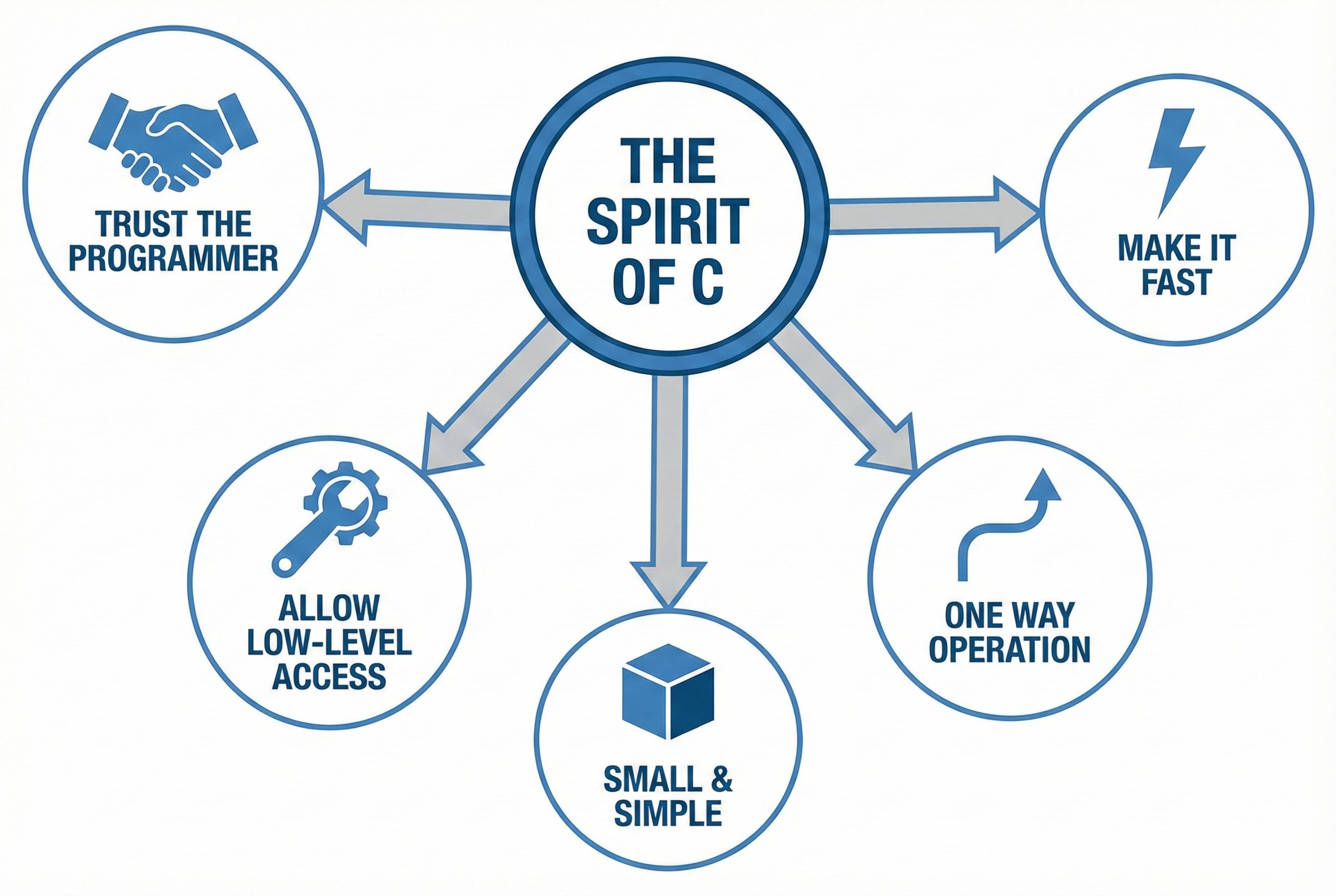
1. Trust the programmer
This is the most important and potentially dangerous rule. C assumes you know exactly what you are doing.
- The Meaning: The compiler generally won’t stop you from doing something risky as long as the syntax is correct.
- The Consequence: If you don’t know what you are doing (e.g., writing past the end of an array), C will let you do it, leading to catastrophic bugs, crashes, or security vulnerabilities.
2. Don’t prevent the programmer from doing what needs to be done
Because C is a system-level language, it must handle low-level tasks efficiently.
- The Meaning: If you need to manipulate memory addresses directly with pointers or perform complex bitwise operations to talk to a hardware register, C provides the tools and gets out of your way. It recognizes that sometimes, these raw operations are necessary.
3. Keep the language small and simple
C was designed to have a small footprint and reside close to the hardware.
- The Meaning: The language structure is not overly complex, and its vocabulary of keywords is small. This makes it easier to build compilers for new architectures and ensures it can run on hardware with limited resources.
4. Provide only one way to do an operation
This is sometimes referred to as the “conservation of mechanism.”
- The Meaning: C tries to avoid redundant features. Keeping the language concise reduces confusion and maintains simplicity in both writing the code and designing the compiler.
5. Make it fast, even if it isn’t guaranteed to be portable
For us in the embedded world, this is paramount. Efficiency is king.
- The Meaning: C prioritizes execution speed above almost everything else. It often offloads the responsibility for “safety” and cross-platform “portability” to the programmer. This is why C code optimized for a desktop PC might crash instantly when deployed on an STM32 microcontroller if you aren’t careful about architecture differences.
Conclusion: The Double-Edged Sword
The Spirit of C is what makes the language so incredibly powerful and fast, making it the undisputed king of Embedded Systems development. However, as the resources warn us, the responsibility rests squarely on your shoulders.
Just because C allows you to do something doesn’t mean it’s the right thing to do. Our job as professional developers is to write code that is not just fast, but also safe and secure. Remember: The C compiler will not hold your hand.
Reference: Effective C: An Introduction to Professional C Programming (Introduction, Page xxiii-xxiv)