The Spirit of C: From Bell Labs to Modern Embedded Systems

The Spirit of C: From Bell Labs to Modern Embedded Systems
Welcome to a history lesson that actually matters for your code. As an instructor, I often tell my students: “To write efficient C, you must understand the mindset of its creators.”
The documentation from Effective C offers a fascinating look into the roots of this language. It wasn’t just written; it was engineered. Let’s break down the history and the core philosophy known as “The Spirit of C,” and why it remains the backbone of modern embedded engineering.
Difficulty: ⭐ (Fundamental)
Time: 10 Minutes
1. The Origins: Born at Bell Labs (1972)
C didn’t appear out of thin air. It was forged with a singular, pragmatic purpose: System Programming.
- The Architects: The language was born in 1972 at Bell Telephone Laboratories, crafted by the legendary duo, Dennis Ritchie and Ken Thompson.
- The Mission: Designed to operate intimately with hardware while retaining the flexibility of a high-level language. This balance allowed it to become the foundation of the UNIX operating system and countless compilers that followed.
2. The Standards Timeline: C89 to C23
For beginners, terms like ANSI C, C99, or C17 can be confusing. Here is the definitive timeline to clear up the ambiguity:
- K&R C (1978): Brian Kernighan and Dennis Ritchie published The C Programming Language. This book served as the de facto standard in the early days.
- ANSI C / C89 (1989): The ANSI committee established the first official standard (ANSI X3.159-1989).
- C90 (1990): ISO adopted the ANSI standard without changes (ISO/IEC 9899:1990). Technically, C89 and C90 are the same code standard.
- Modern Standards (C99, C11, C17, C23): The language evolved to include new features. While many legacy embedded systems still rely on C89/C90, modern toolchains (like GCC in STM32CubeIDE) fully support C11, C17, and increasingly, C23.
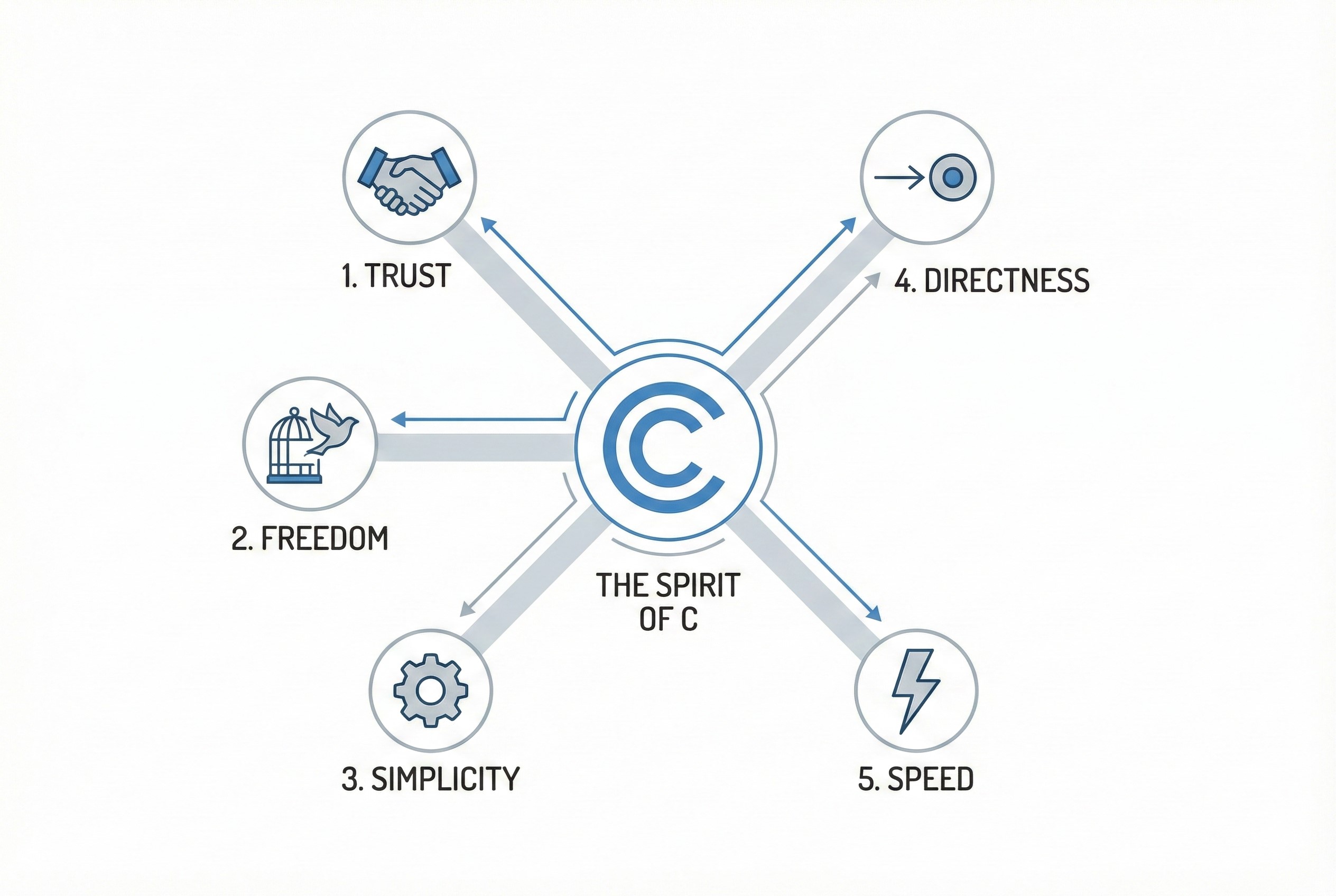
3. The Spirit of C: 5 Core Philosophies
Why does C remain at the top of the TIOBE Index after 50 years? It comes down to its design philosophy, famously known as “The Spirit of C.”
- Trust the programmer: C assumes you know what you are doing. If you want to manipulate memory directly, C will let you, even if it risks crashing the system.
- Don’t prevent the programmer from doing what needs to be done: As a system-level language, it must allow full access to the hardware (Low-level operations).
- Keep the language small and simple: The core language is compact, making it ideal for hardware with limited resources (like Microcontrollers).
- Provide only one way to do an operation: It avoids redundancy to maintain clarity and compiler efficiency.
- Make it fast: Performance is king. C prioritizes execution speed, sometimes at the expense of safety or cross-platform portability.
4. Conclusion: Why We Still Learn C
Despite the rise of Rust, Python, and others, Effective C confirms that “The world still runs on C.” Windows, Linux, macOS, and the kernels of high-level languages like Python and Java all trace their roots back to C.
For us in the Embedded Systems world, understanding this history is crucial. It reminds us that C gives us “Great Power” (high performance), but it also demands “Great Responsibility” (manual memory management and safety checks).
Master the spirit, and you master the machine.