Freestanding Environment: The True Bare-Metal Arena for Hardware Programmers

Freestanding Environment: The True Bare-Metal Arena
Hello embedded engineers and developers of the 123microcontroller community! Welcome back to another deep dive. Today, we’re exploring the core “Execution Environments” in C programming.
When we learn C programming on a PC, we comfortably #include <stdio.h> and call printf() or malloc() without a second thought. However, once we step into the world of Embedded Systems and write bare-metal code for microcontrollers, those familiar functions suddenly vanish!
This happens because the C standard defines two primary execution environments: the Hosted Environment (supported by an OS) and the Freestanding Environment (no OS). Let’s crack open the standard specifications and see what Freestanding means for us hardware developers.
What is a Freestanding Environment?
In the broader context of execution environments, the C standard defines the Freestanding Environment as follows:
- No Operating System: A freestanding environment is where a C program executes completely on its own, without any assistance or resources from an Operating System (OS). This is the standard realm of bare-metal firmware for microcontrollers or even OS kernel development.
- The Entry Point is Not Always
main(): In a Hosted Environment, the entry point must strictly beint main(void). In the Freestanding world, program startup is implementation-defined. For embedded systems, the actual entry point is often a function likeReset_Handler, called directly from the hardware’s Interrupt Vector Table upon power-up. - A Stripped-Down Standard Library: Since there’s no OS to handle file I/O or display consoles, a freestanding compiler is not required to provide libraries like
<stdio.h>,<stdlib.h>, or<string.h>. It only guarantees the most fundamental header files:<float.h>,<limits.h>,<stdarg.h>,<stddef.h>,<stdbool.h>,<stdint.h>, and<iso646.h>. - The
__STDC_HOSTED__Macro: The C99 standard gives us a macro to check our environment at compile-time. If__STDC_HOSTED__evaluates to0, we are in a Freestanding environment. If it’s1, we are in a Hosted environment.
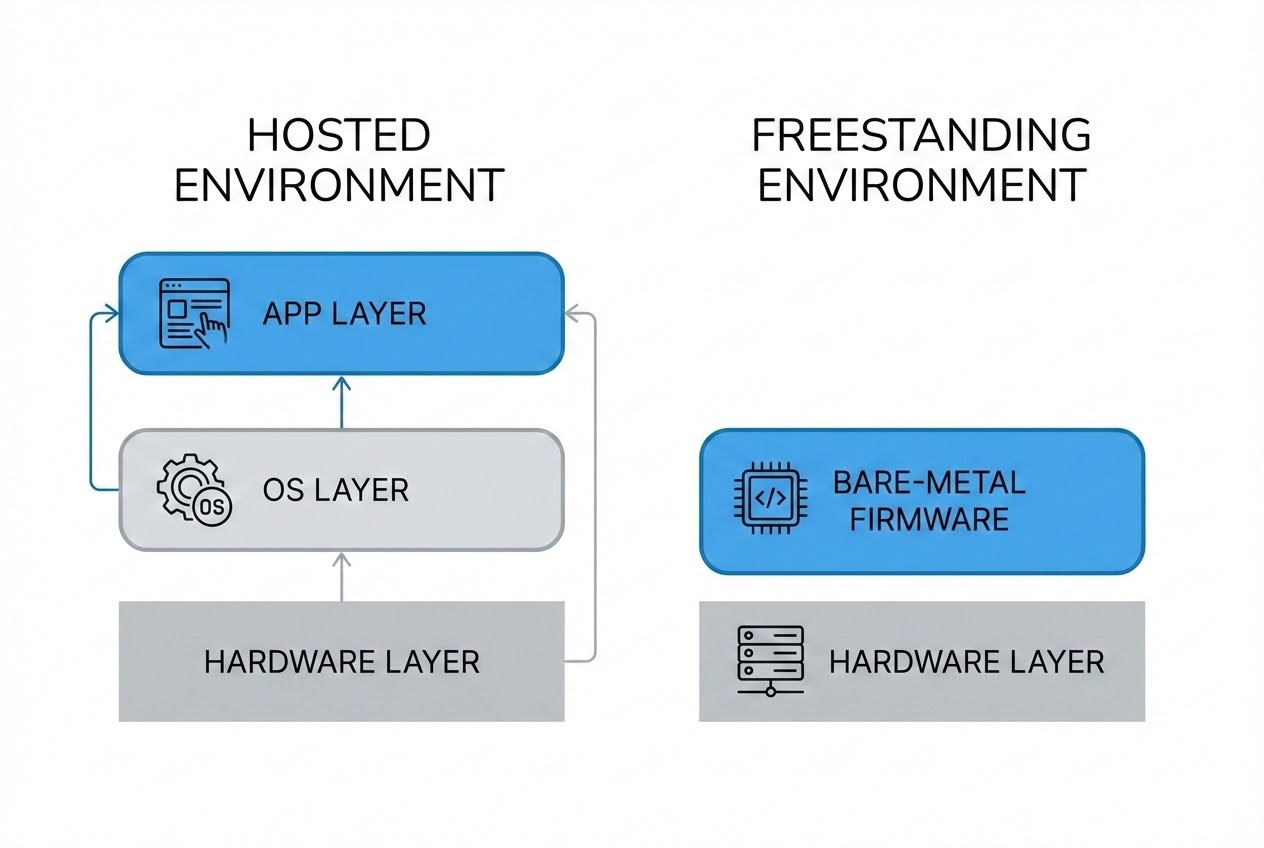
Code Example: Cross-Environment Compatibility
Let’s see how we can utilize __STDC_HOSTED__ to write clean code that compiles seamlessly on both a PC (for simulation) and a real microcontroller in a freestanding mode.
#include <stdint.h>
#include <stdbool.h>

/*
 * 1. Check the system environment using the Preprocessor
 * If __STDC_HOSTED__ is 0, we are in a Freestanding environment (e.g., MCU board)
 */
#if __STDC_HOSTED__ == 0

    /* 🛡️ Freestanding Environment: No <stdio.h> available */
    #define HARDWARE_LED_PORT (*(volatile uint8_t *)0x40021000)

    void system_log(const char* msg) {
        /* Instead of printing to a console, we send strings via UART (simulated here) */
        // uart_send_string(msg);
    }

    /* The entry point might not be main(), but we simulate it as main here */
    int main(void) {
        system_log("System Started in Freestanding Mode");
        HARDWARE_LED_PORT = 0x01; /* Turn on LED directly via hardware register */
        while(1) { /* Infinite loop for embedded systems */ }
        return 0;
    }

#else

    /* 2. Hosted Environment (e.g., compiling on Windows/Linux) */
    #include <stdio.h> /* Full I/O functionality available */

    void system_log(const char* msg) {
        printf("[LOG]: %s\n", msg);
    }

    int main(void) {
        system_log("System Started in Hosted Mode");
        return 0; /* Return execution control to the OS */
    }

#endif
Best Practices & Pitfalls
Programming in a freestanding environment is a hardcore task. Based on software engineering principles and system tuning, here are the crucial pitfalls to avoid:
- Forget About
malloc()andfree(): In severely memory-constrained freestanding systems, programmers must manually manage memory. Some systems might not even have a Heap allocated! Using dynamic memory allocation in embedded systems is risky and often leads to memory leaks or fragmentation. Avoid it whenever possible. - Compiler Flags: If you are using GCC to compile your bare-metal code, always include the
-ffreestandingflag. This explicitly tells the compiler not to rely on standard library functions and disables certain built-in optimizations (like injectingmemcpyautomatically when copying structs). - Beware of Floating-Point Types: In a freestanding environment, your MCU chip might not feature a Hardware FPU (Floating Point Unit). If the system lacks a software floating-point library, using
floatvariables could crash your code or severely degrade performance due to software emulation overhead.
Conclusion
The Freestanding Environment is the sacred ground for hardware programmers. It’s a world where your code stands entirely on its own—no OS managing files, no easy printf() calls, just you, the CPU, and a handful of foundational C libraries. But this exact rawness is the true charm of unlocking hardware’s maximum potential!
If you’re starting with bare-metal C and struggling with missing header files or complex Linker Script configurations, don’t hesitate to drop by and share your projects on our community board at www.123microcontroller.com! See you in the next article. Happy Coding!