Deep Dive into CMSIS: The Universal Language of ARM Cortex-M

Deep Dive into CMSIS: The Rulebook of the ARM Cortex-M World
Hello Developers! Welcome back to our systems theory class. Today, we are dissecting CMSIS (Cortex Microcontroller Software Interface Standard)—the “common tongue” for the ARM Cortex-M ecosystem.
If you’ve ever wondered why moving code between different ARM chips feels like a nightmare of register renaming, or why FreeRTOS libraries look so layered, the answer lies within this standard.
1. What is CMSIS? (The Universal Standard)
CMSIS is a vendor-independent hardware abstraction layer for microcontrollers that are based on the ARM Cortex-M processor series. It was developed by ARM in collaboration with silicon vendors (ST, TI, NXP) and tool providers (Keil, IAR).
The Goal: To enable code portability and reduce the learning curve for new developers.
Analogy: > * ARM Core: The engine (identical across brands).
- Peripherals (GPIO, UART): The car body and steering (ST designs it one way, NXP another).
- CMSIS: The “Standard Manual” that ensures the brake pedal and ignition are always in the same place, regardless of the brand.
2. Core Components of CMSIS
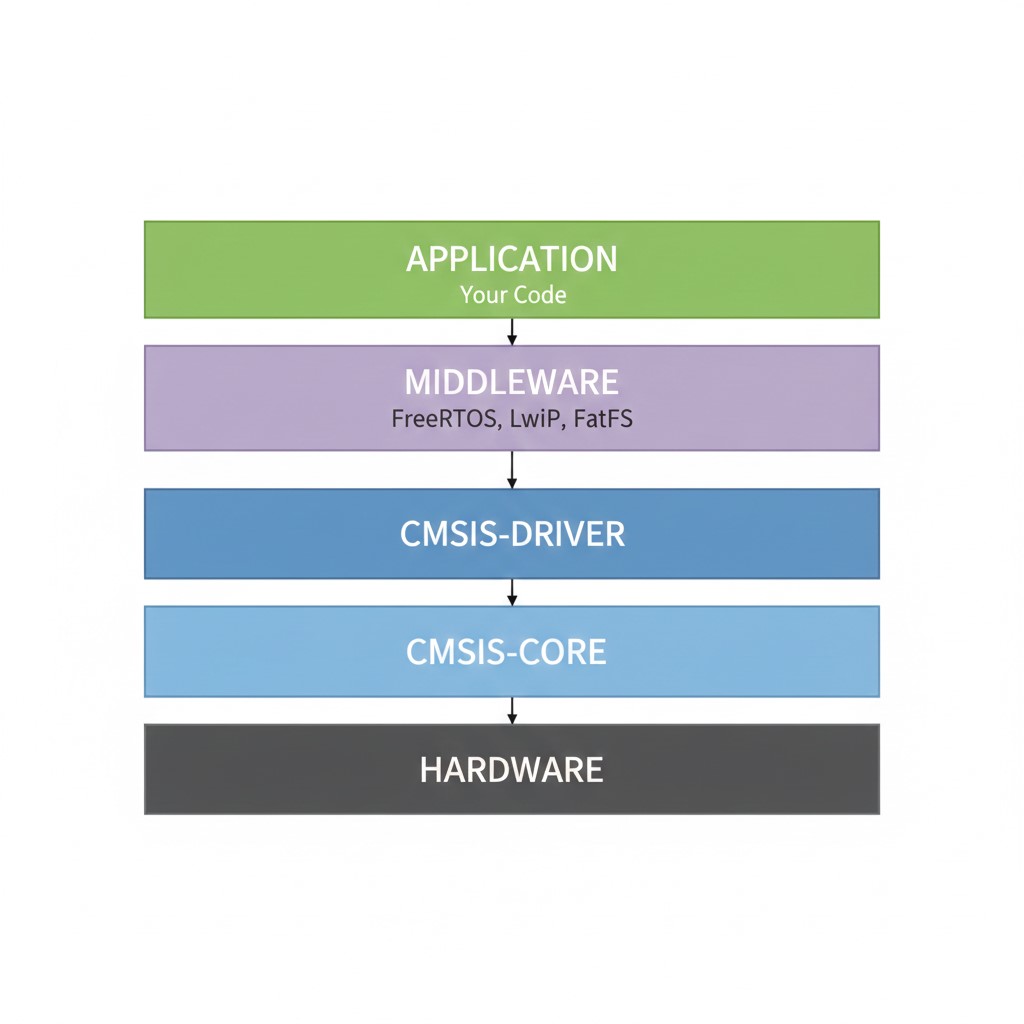
In a modern project (like those in STM32CubeIDE), you will encounter these specific layers:
2.1 CMSIS-CORE: The Vital Heart
This is the most critical layer. It allows the software to communicate with the Core Peripherals (the parts owned by ARM, not the silicon vendor).
- Role: Manages the NVIC (Nested Vectored Interrupt Controller), SysTick Timer, MPU, and FPU.
- In Code: Functions like
NVIC_EnableIRQ()orSystemInit()are part of CMSIS-CORE.
2.2 CMSIS-RTOS (v1 & v2): The OS Wrapper
CMSIS-RTOS is not an Operating System itself; it is an API Wrapper.
- How it works: Under the hood, you might be running FreeRTOS or Keil RTX. However, you call standardized functions like
osThreadNew()instead of nativexTaskCreate(). - Pros: High portability. Switch the underlying RTOS without changing your application logic.
2.3 CMSIS-DSP & NN: The Mathematical Brain
- CMSIS-DSP: Over 60 optimized math functions (FFT, PID, Matrix). It utilizes SIMD instructions on Cortex-M4/M7 to run significantly faster than standard C code.
- CMSIS-NN: Optimized kernels for Neural Networks, enabling TinyML on low-power MCUs.
3. Architecture Overview Table
| Layer | Role | Example Files/Functions |
|---|---|---|
| Application | Your logic (Blinky, Control) | main.c |
| CMSIS-RTOS | OS Abstraction | cmsis_os.h |
| Middleware | Ready-to-use stacks | LwIP, FatFS, FreeRTOS |
| CMSIS-Driver | Peripheral Standard API | Driver_USART.c |
| CMSIS-CORE | CPU Core Management | core_cm4.h |
4. Architect’s Verdict 💡
- Must Know: CMSIS-CORE is mandatory. Tools like CubeMX generate this for you—don’t modify it manually.
- Highly Recommended: Use CMSIS-DSP if you are doing signal processing. Never write your own Matrix multiplication; the CMSIS version is far more optimized.
- The Choice: Use CMSIS-RTOS for standard projects to keep code clean. However, if you need advanced FreeRTOS features (like Stream Buffers), calling the native API is perfectly acceptable.