Solidifying C++ Fundamentals: Understanding Types and Variables

Solidifying C++ Fundamentals: Understanding Types and Variables
Hello fellow developers! Today, we’re diving into the absolute “first button” of programming in C++: the core concepts of Types and Variables.
Many might consider this a basic topic that everyone already knows. However, in the context of C++, truly understanding these two elements is the crucial key to writing type-safe code and extracting maximum performance from your hardware. Whether you are developing desktop applications or writing low-level firmware for a microcontroller, let’s explore the hidden mechanisms behind Types and Variables in C++.
Core Concepts of Data Management
In C++, a “program” is essentially the manipulation and processing of data. Here is how we define the concepts of Types and Variables:
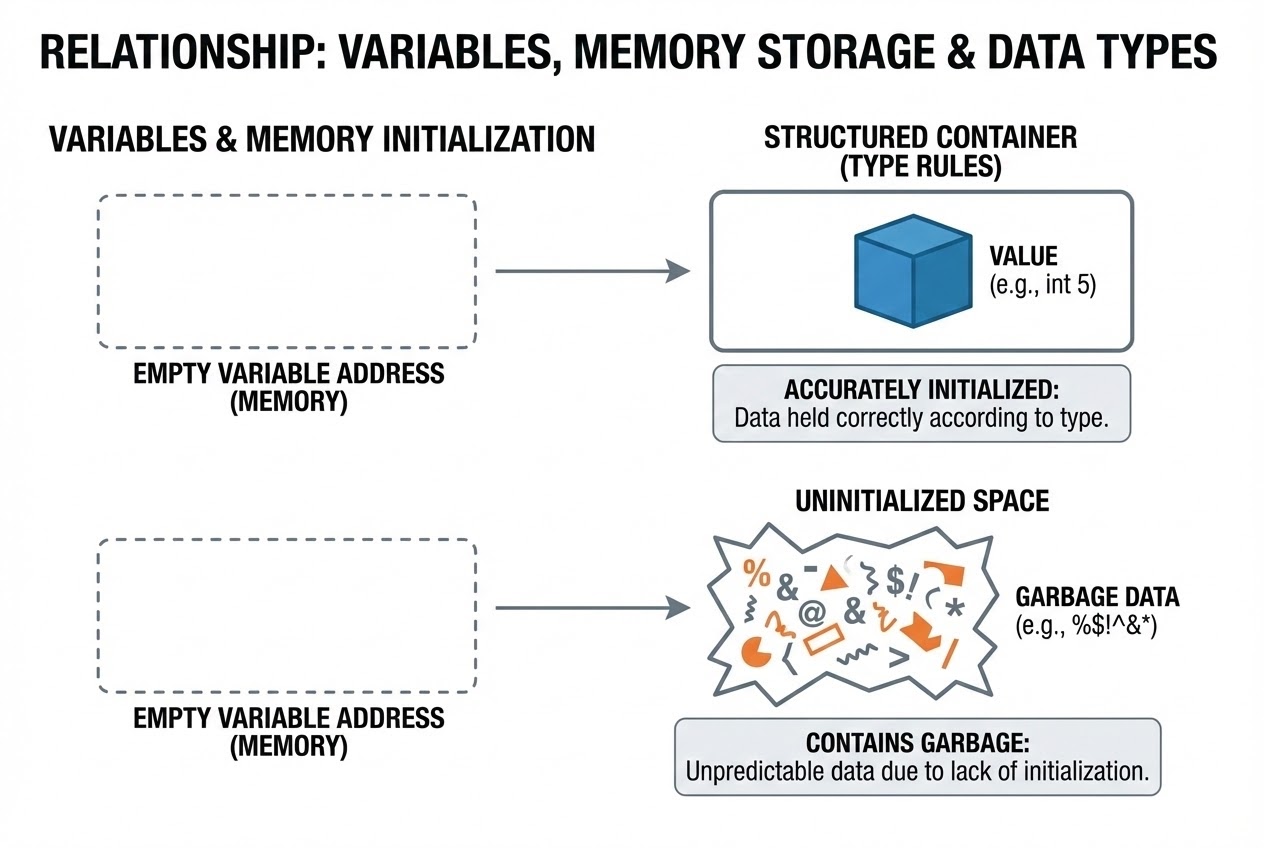
- Variables (The Storage Boxes): Inside our computer, Memory is divided into a massive number of slots. Remembering the exact address (hexadecimal numbers) of these memory locations would be a nightmare. C++ allows us to create “variables,” which act like labels attached to these memory storage boxes, making it easy to store, retrieve, and change data.
- Types (The Box Rules): Having just a box name is not enough. We must tell the compiler what “type” of data this box holds. The data type determines how many bytes of memory the box will consume, what values it can store, and what operations are legally permitted on it.
- Statically Typed Language: C++ is statically typed, meaning the compiler must know the data type of every variable at compile time. This strictness allows the compiler to catch errors for us long before the program is actually executed.
- Categories of Types: C++ classifies data types into two primary groups:
- Fundamental Types: Such as
int(integers),double(floating-point numbers),char(characters), andbool(booleans). These types map directly to hardware capabilities, making operations extremely fast. - User-Defined Types: Because the real world involves complex concepts, C++ allows us to construct new data types via Classes, Structs, and Enumerations. This enables us to assemble fundamental variables to represent real-world entities (e.g., creating a
Pointtype containing x and y coordinates).
- Fundamental Types: Such as
- Initialization: When you create a variable, if you don’t provide an initial value, C++ doesn’t clear the memory for you. Instead, the variable holds “garbage” values left over in that memory location. This is a notorious source of bugs. Therefore, you should always cultivate the habit of initializing variables upon creation.
Code Example: Modern C++ Approach
Let’s look at an example of variable declaration and type management using Modern C++ paradigms. Below is a clean code implementation:
#include <iostream>
#include <string>

// Creating a User-Defined Type using a Struct
struct SensorData {
    int sensorId;
    double temperature;
};

int main() {
    // 1. Traditional variable declaration (Uninitialized - Beware of garbage values!)
    int uninitializedVariable;

    // 2. Uniform Initialization (Recommended since C++11)
    int motorSpeed { 255 };
    double piValue { 3.14159 };

    // Leaving the braces empty performs Zero-initialization
    int defaultCounter {};

    // 3. Utilizing our User-Defined Type
    SensorData roomSensor { 1, 25.5 };

    // 4. Using Type Deduction (auto) to let the compiler infer the type from the value
    auto isSystemActive { true };  // Compiler maps this to bool
    auto message { "System Started!" }; // Compiler maps this to const char*

    std::cout << message << "\n";
    std::cout << "Motor Speed: " << motorSpeed << "\n";
    std::cout << "Sensor " << roomSensor.sensorId << " Temp: " << roomSensor.temperature << "\n";

    return 0;
}
Best Practices and Precautions
Drawing from secure coding standards (like SEI CERT C++ and Clean C++), here are essential recommendations to keep in mind:
- Always use Uniform Initialization (
{}): Using braces for initialization not only works universally across all data types but also prevents Narrowing Conversions (accidental loss of precision). For instance, if you writeint x { 3.14 };, modern compilers will immediately throw an error to prevent the decimal truncation (whereas the legacy=assignment would quietly drop the decimal). - Initialize variables immediately: Using uninitialized variables leads to Undefined Behavior (UB). Your program might crash or yield erratic results randomly.
- Use descriptive naming conventions: Avoid cryptic abbreviations like
x1,x2, or visually confusing characters likeO(letter O) vs0(zero), orl(lowercase L) vs1(one). A good variable name should clearly express what data it holds. - Leverage
autoto reduce verbosity: Usingautoforces you to initialize the variable (otherwise, the compiler can’t deduce the type). It also serves as an excellent safeguard against unintended type conversions.
Conclusion
To briefly summarize: in the C++ ecosystem, Variables are named memory spaces, and Types are the rules that enforce safety for those spaces. Grasping this relationship and adopting Modern C++ initialization techniques ({}) will guarantee that your code is both secure and highly performant!
If you’re eager to apply these C++ fundamentals to hardware control programming or exciting IoT projects, be sure to follow more articles and projects at www.123microcontroller.com. See you in the next tutorial. Happy Coding!