Unboxing C++ 'Program' Structure: A Deep Dive for Developers and Hardware Engineers

Anatomy of a C++ Program
Hello fellow developers and hardware hackers at 123microcontroller.com! Today, we’re going to deep dive into a topic that might seem incredibly basic but is fundamentally vital. We will answer the question: “From a C++ perspective, what exactly is a ‘Program’?”
Many developers, especially when starting out with C++ in the Arduino or ESP32 ecosystem, simply write code, hit “Verify”, and upload. However, understanding the core basics of how our code is physically assembled into a “Program” is crucial. This architectural knowledge drastically reduces headaches when you encounter bizarre build errors—especially Linker errors—or when you’re deploying bare-metal logic to a microcontroller. Let’s explore what goes on behind the scenes!
Core Concepts of C++ Compilation
In the broader landscape of C++ fundamentals, the nature of a “Program” is defined by a few critical principles:
- A Program is a Comprehensive Sequence of Instructions: At its core, a program is a self-contained set of instructions telling the computer exactly how to process data to generate intended outputs. Because processors lack human intuition, a C++ program must define every single computational step with absolute precision.
- Execution Always Begins at
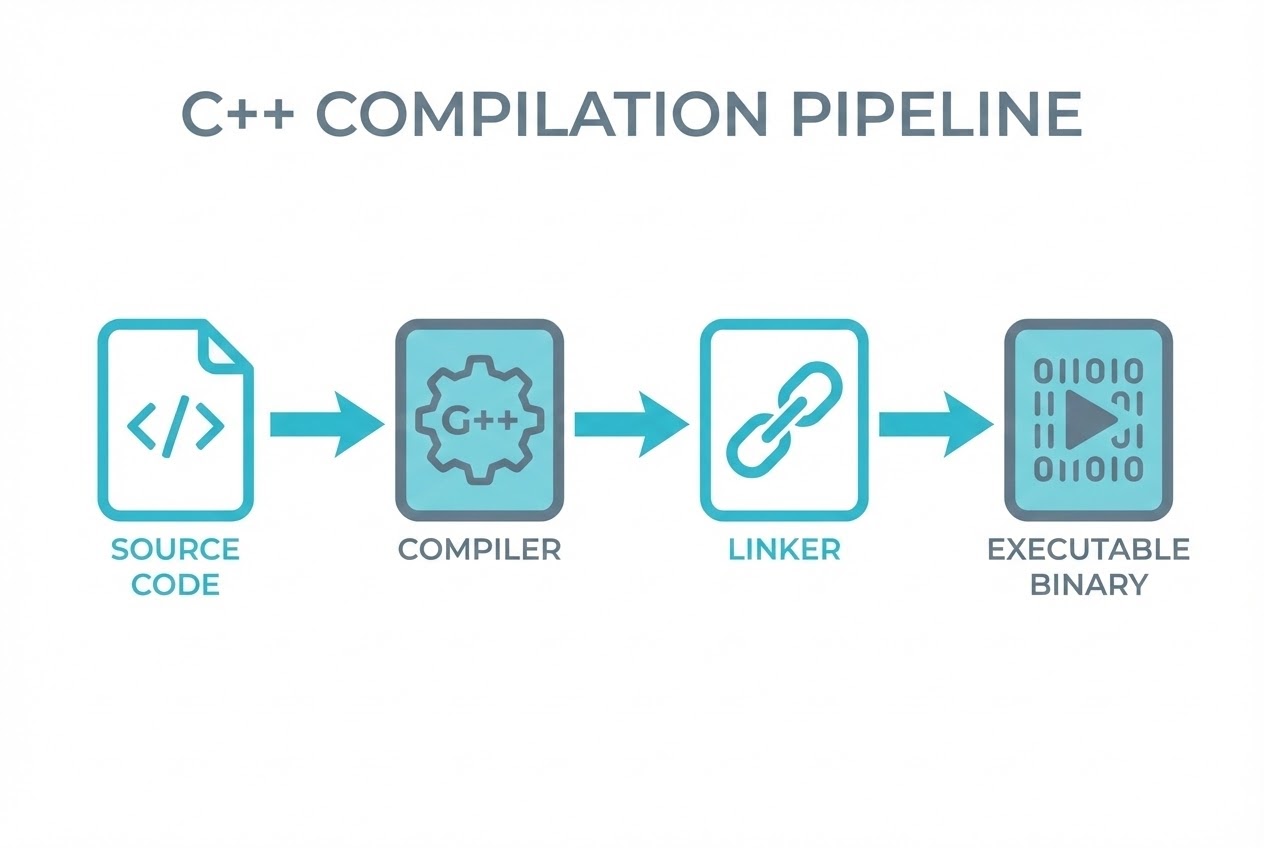
main(): The golden rule of standard C++ is that a program must possess exactly one globally defined function namedmain(). Regardless of whether your firmware is massive or utilizes complex concurrent threads (like FreeRTOS), the operating system (or standard startup routine) always searches for themain()function as the primary ignition point to begin execution. - It is a Compiled Language: Unlike interpreted scripts (like Python or JavaScript) that translate code on the fly, C++ applications are systematically built via a three-staged pipeline:
- Preprocessor: Resolves directives starting with
#, such as#include, bringing in required header files. - Compiler: Translates your human-readable source code into machine-level instructions forming Object files (
.oor.obj). - Linker: Fetches all generated object files and links them tightly with any external library dependencies to forge a centralized, ready-to-run Executable program (or firmware binary image like
.binor.elf).
- Preprocessor: Resolves directives starting with
- Hardware Portability Misconceptions: A common myth is that a compiled C++ executable can run on any machine. In reality, the final executable is highly specific to the targeted hardware architecture and OS (a compiled Windows executable will not run directly on an ESP32). What is truly “portable” is the Source Code itself, which can be cleanly recompiled (cross-compiled) for various target hardware architectures.
- Standard Library Dependency: A secure, high-quality program rarely reinvents the wheel. Modern C++ comes heavily equipped with the Standard Library (handling tasks like I/O Streams
<iostream>and fundamental data structures), allowing developers to piece together sophisticated implementations safely and efficiently.
Clean Architecture Code Example
Let’s look at the structure of a robust, modern “Hello World” application in C++:
// Preprocessor directive: Injects the standard I/O library
#include <iostream>

// The mandatory entry point for any standard C++ program
int main() {
    // Variable declaration using Uniform Initialization (highly recommended)
    int startValue { 100 };

    // Outputting to the console leveraging the Standard Library
    std::cout << "System initialized with value: " << startValue << "\n";

    // Returning 0 to the Operating System indicates a completely successful execution
    return 0;
}
Technical Context: Once the Compiler maps this code into an Object file, the Linker dynamically locates the precise functional implementation of std::cout from your system’s compiled library toolkit and embeds it into your final runnable binary.
Secure Coding Best Practices
Drawing insights from strict standards like SEI CERT C++ and Clean C++ guidelines, here is a quick look at professional Do’s and Don’ts:
- Always explicitly return from
main(): Even though modern standard compilers will silently pad areturn 0;block for you if forgotten, in a professional codebase, explicitly writingreturn 0;signals unambiguous intent: the program formally reports a successful exit state to the environment. - Avoid the “Big Ball of Mud”: Do not stuff all logic directly into
main(). A highly dependable program is meticulously modular. Separate specific logic into distinct functions and modular classes. This ensures readability, testability, and painless debugging. - Leverage the Standard Library First: Don’t reinvent the wheel. If you need dynamic arrays, lists, or string manipulations, use robust Standard Library components instead of manually hand-rolling vulnerable C-style equivalents. Standard components are rigorously tested and highly optimized.
- Beware of Undefined Behavior (UB): C++ compilers ruthlessly optimize your firmware logic under the assumption that you strictly follow the language’s safety rules. Should you access out-of-bounds memory or violate type safety, the compiler may legally process your code into erratic, unpredictable instructions.
Conclusion
To briefly summarize, a Program inside the C++ ecosystem isn’t just raw text meant to magically compute. It is a strictly typed architecture that must pass precisely through compiling and linking pipelines, inherently utilizing the main() function as the gatekeeper. Understanding this structural chain provides the architectural insight needed to debug terrifying linker failures and elevate your firmware development process!
If you enjoyed peeling back the layers of C++ structures and wish to learn how to organize algorithms perfectly suited for hardware components, stick around for more deep-dive C++ tactics and microcontroller adventures at www.123microcontroller.com. See you in the next build!