Deep Dive into C Preprocessor: The Source Code Magic Behind Embedded Systems

Mastering the Preprocessor for Hardware Control
Hello fellow engineers and developers at 123microcontroller.com! Today, we are going to talk about the “magic” behind System Programming in C and C++: the C Preprocessor.
Many of you have been typing #include <stdio.h> or #define since day one of learning to code. But did you know that in the world of Embedded Systems—where hardware resources are extremely constrained and diverse—the Preprocessor is the ultimate hero? It helps manage our codebase with maximum efficiency. Today, we’ll dive deep into what legendary resource guides and Secure Coding standards actually say about utilizing the C Preprocessor in a hardware context!
The Role of the Preprocessor in Embedded Systems
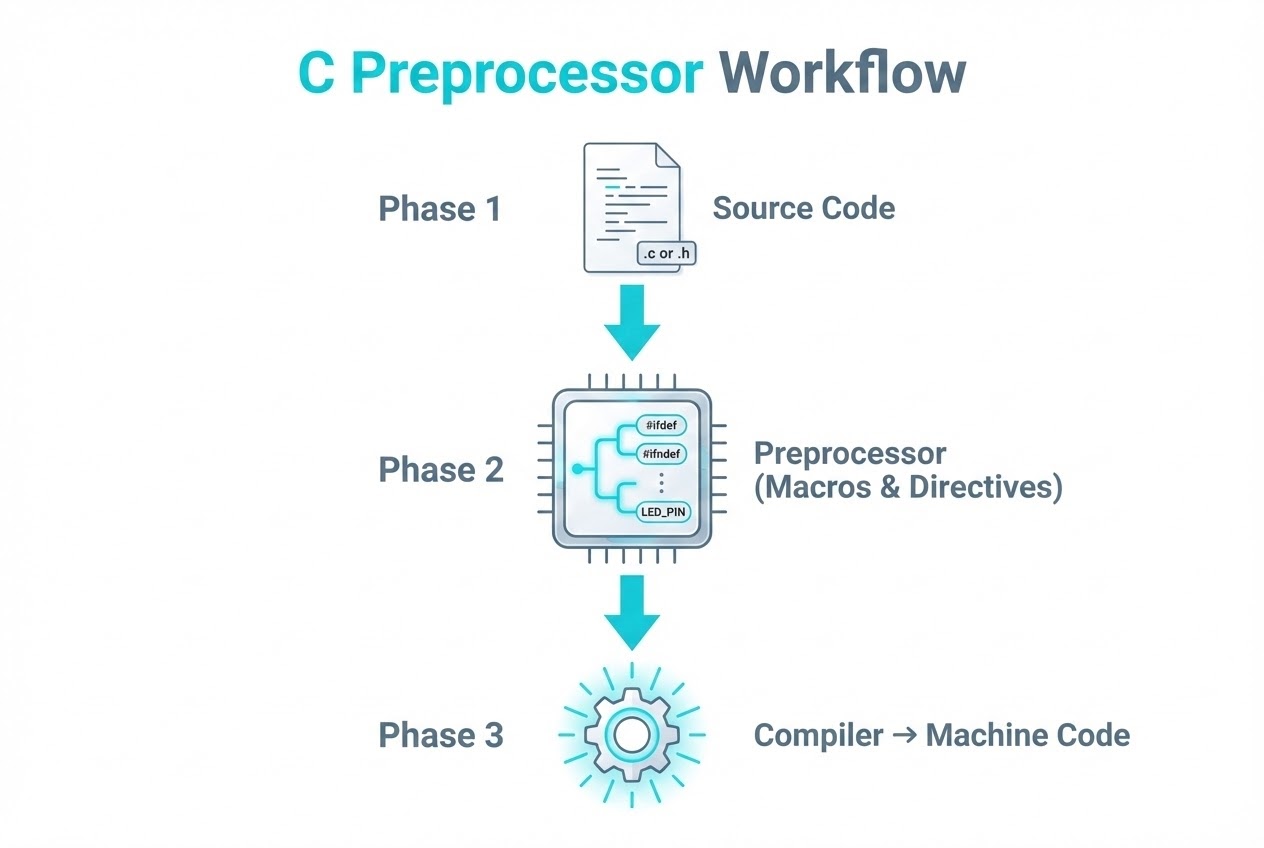
To put it simply, the C Preprocessor acts as an “Assistant Editor.” It thoroughly reviews and modifies the text of your Source Code before handing the final draft over to the Compiler to be transformed into Machine Code. This phase is naturally called Preprocessing and represents the very first step in the compilation pipeline. You can easily spot these commands because they always begin with a #, and rarely end with a semicolon (;).
In microcontroller programming, the Preprocessor plays an incredibly vital role that goes far beyond just including Header files:
- Managing Registers and Eliminating Magic Numbers (
#define): When controlling hardware, we constantly manipulate Memory Addresses. By using#defineto create Macros or Symbolic Constants, we assign readable names instead of raw, confusing hexadecimal numbers. This keeps our code clean. Furthermore, if the hardware mapping changes in a future revision, we only need to update the address in one single place. - Conditional Compilation:
This is an absolute godsend feature for hardware developers! With directives like
#if,#ifdef,#ifndef,#else, and#elif, we can command the Compiler to “choose” which exact blocks of code to compile by evaluating conditions entirely during Compile-time.- Hardware Portability: Suppose we have a product with 3 variants. We can use a single unified codebase! By utilizing the Preprocessor, we flag which registers or functions to compile based on the target board. Any unused code is utterly ignored, consuming absolutely zero bytes of your precious ROM (Flash) memory.
- Toggling Target Debug Code: We often embed
printffunctions to output variable states via UART during debugging. When releasing the production firmware, we can instantly turn off all these statements using#ifdef DEBUG. This shrinks the firmware size and significantly boosts execution speed.
- Preventing Duplicate Includes (Include Guards):
Embedded projects usually contain dozens of interconnected Header files. Utilizing
#ifndefcombined with#defineat the top of your files constructs an “Include Guard,” effectively preventing the Compiler from processing the same data structure definitions multiple times. - Compiler-Specific Instructions (
#pragma): These are highly specialized directives whose behaviors depend entirely on the specific Compiler brand. They are primarily used to inform the Compiler about specific microcontroller features—such as declaring an Interrupt Service Routine (ISR) or enforcing strict Memory Alignment. - Deploying Emergency Compilation Stops (
#error): If a developer forgets to configure a critical Macro or targets the wrong hardware architecture, we can leverage#errorto violently halt the compilation process immediately while printing a custom warning message.
Clean Architecture Code Example
Let’s examine a practical Preprocessor hardware setup. This snippet simulates maintaining a single codebase to support two entirely different hardware board revisions.
#include <stdint.h>
/* Inject microcontroller-specific header files (e.g., STM32 or PIC) */
// #include "micro_registers.h"

/*
 * 1. Hardware Control via Conditional Compilation
 * Assume during compilation, we pass the flag: -DBOARD_VERSION=2
 */
#define BOARD_VERSION 2

#if BOARD_VERSION == 1
    /* Version 1 utilizes Port A, Pin 5 */
    #define LED_PORT_REG (*(volatile uint32_t *)(0x40020000 + 0x14))
    #define LED_PIN      (1 << 5)
#elif BOARD_VERSION == 2
    /* Version 2 featured a hardware redesign, now using Port B, Pin 3 */
    #define LED_PORT_REG (*(volatile uint32_t *)(0x40020400 + 0x14))
    #define LED_PIN      (1 << 3)
#else
    /* 2. Catch Compile-time Errors if the board version is omitted */
    #error "Please correctly define BOARD_VERSION (1 or 2)"
#endif

/* 3. Generating Function-like Macros for highly readable Bitwise Operations */
/* CAUTION: NEVER forget to heavily wrap all parameters in parentheses! */
#define SET_BIT(REG, BIT)   ((REG) |= (BIT))
#define CLEAR_BIT(REG, BIT) ((REG) &= ~(BIT))

/* 4. Toggling the Debug Output */
#define DEBUG_MODE 1

#if DEBUG_MODE
    #include <stdio.h>
    #define DEBUG_PRINT(msg) printf("DEBUG: %s\n", msg)
#else
    /* If Debug is disabled, replace with absolutely nothing to save Flash/RAM */
    #define DEBUG_PRINT(msg)
#endif

int main(void) {
    DEBUG_PRINT("System Initialization...");

    while(1) {
        /* Highly readable sequence; no raw memory addresses in sight! */
        SET_BIT(LED_PORT_REG, LED_PIN);   /* Turn on LED */

        // delay_ms(500); /* Assuming a blocking hardware delay function exists */

        CLEAR_BIT(LED_PORT_REG, LED_PIN); /* Turn off LED */
    }
    return 0;
}
Best Practices and Safety Warnings
While the C Preprocessor is astoundingly powerful, it acts as a very sharp double-edged sword. High-security standards like the SEI CERT C Coding Standard and Expert C Programming literature provide stern warnings regarding its usage:
- Beware of Side Effects in Function-like Macros (Rule PRE31-C):
Imagine a simple maximum value Macro:
#define MAX(x, y) ((x) > (y) ? (x) : (y))If you carelessly invoke it like this:MAX(a++, b), the Preprocessor expands it directly into text:((a++) > (b) ? (a++) : (b)). The devastating result is that variableacould inadvertently be incremented twice in a single pass! (Double evaluation). Therefore, you must rigorously avoid passing parameters containing side-changing effects into Macros. - Always Enforce Extensive Parentheses:
The Preprocessor possesses zero comprehension regarding mathematical Operator Precedence. It executes purely blind text substitution.
For example:
#define SQUARE(x) x * x. If you callSQUARE(3 + 1), it translates to3 + 1 * 3 + 1, which evaluates to 7 instead of the intended 16! Customarily, you must wrap both the overarching expression and every individual parameter in parentheses:#define SQUARE(x) ((x) * (x)). - Utilize
do { ... } while(0)for Multi-statement Macros: When crafting a Macro consisting of multiple commands, invoking it directly underneath anifstatement that lacks{}braces often triggers the notorious Danglingelsebug. Wrapping your execution code tightly within ado { ... } while(0)shell inherently forces the Compiler to treat it as one unified, safely encapsulated statement resembling a true function call. - Prioritize
constorinlineFunctions Whenever Feasible: To enforce rigorous Type Safety, modern C/C++ architectures strongly dictate utilizingconstvariables over arbitrary#definenumeric constants, and deployinginlinefunctions over inherently risky Function-like macros. By following this route, the Compiler acts as an active guardian.
Conclusion
The C Preprocessor is not merely a rudimentary find-and-replace text tool. It is an industrial-grade instrument facilitating Embedded engineers in dominating hardware complexity. It dynamically sculpts extremely portable codebases across diverse microchip ecosystems while enabling hyper-intelligent memory curation. Simultaneously, you must wield it cleanly, adopting modern Best Practices, lest you summon elusive compiler bugs capable of stalling your entire firmware lifecycle.
Hopefully, this deep dive brightly illuminated how to architecturally weaponize Preprocessor concepts straight into your microcontroller builds! For those craving more advanced C hardware wizardry or looking to conquer tricky hardware Register mechanics, stick closely with our exclusive insights at www.123microcontroller.com. See you in the next build session. Happy Coding!