#include and Header Files: The Copy-Paste Magic of the C Preprocessor in Embedded Systems

Introduction: The Invisible Architecture Connecting Multi-File Projects
Greetings, elite engineers and bare-metal developers actively guarding the www.123microcontroller.com grid! The dark-eyed engineer has logged securely back into the terminal. Today, we are violently tearing into one of the most fundamentally critical, yet horribly misunderstood, backstage mechanisms powering the entire C/C++ programming language: The C Preprocessor. Specifically, we will be dissecting the legendary #include directive and the operational logistics governing robust Header Files.
When we lay down code commanding microcontrollers, our project payloads inevitably bloat exponentially, absorbing hundreds of sensors and massive feature algorithms. We rapidly cross the threshold where forcefully cramming seventy thousand lines of logic into a solitary, bloated main.c file becomes mathematically impossible and organizationally fatal. We are strictly forced by engineering doctrine to shatter our source code into highly compartmentalized, isolated modules (Modular Programming). However, attempting to force these wildly isolated modules to successfully detect and “communicate” with each other absolutely requires the intervention of an invisible hero: The C Preprocessor. Today, we crack open the Master Architecture texts identifying precisely how this mechanism executes text substitution, and how elite hardware developers exploit it to construct beautifully structured, bug-free, and highly lethal compilation processes!
Core Theory Autopsy: The Preprocessor Robot & the Brutal Mechanics of #include
Deep inside the violent C/C++ compilation pipeline architecture, long before our human-readable ASCII source text is brutally crushed and compiled down into executable silicon Machine Code, it is absolutely forced to survive a vital preliminary checkpoint designated as the C Preprocessor. Visualize this Preprocessor explicitly as an uncompromising “Automated Copy-Paste Typewriter Robot” or a massive “Specialized Text Substitution Editor.” It strictly obeys specialized commands hidden inside our code to violently yank, rip, and replace raw text. The absolute universal parameter governing this phase asserts: Any command actively commanding the Preprocessor directly must identically lead exclusively utilizing the Hash symbol prefix (#).
Undoubtedly, the absolute most devastatingly powerful, frequently abused, and heavily utilized command residing within this arsenal is #include. In the clinical definition of the Preprocessor’s operational theater, elite documentation defines its behavior with terrifying simplicity:
- 1. The Brutal Force Mechanism (Verbatim Text Insertion):
The microsecond the robotic Preprocessor scanner crashes into an
#includedirective string, the absolute ONLY objective it executes is to “aggressively delete that specific instruction line, forcefully teleport to reading the exact target file requested, and violently rip copying 100% of that external text, forcefully pasting it directly dropping it into that exact gaping hole in your source code!” (Verbatim Insertion). It executes zero syntax validation. It possesses zero functional intelligence. It simply copies and pastes blindly! - 2. Navigation Protocol Arrays (
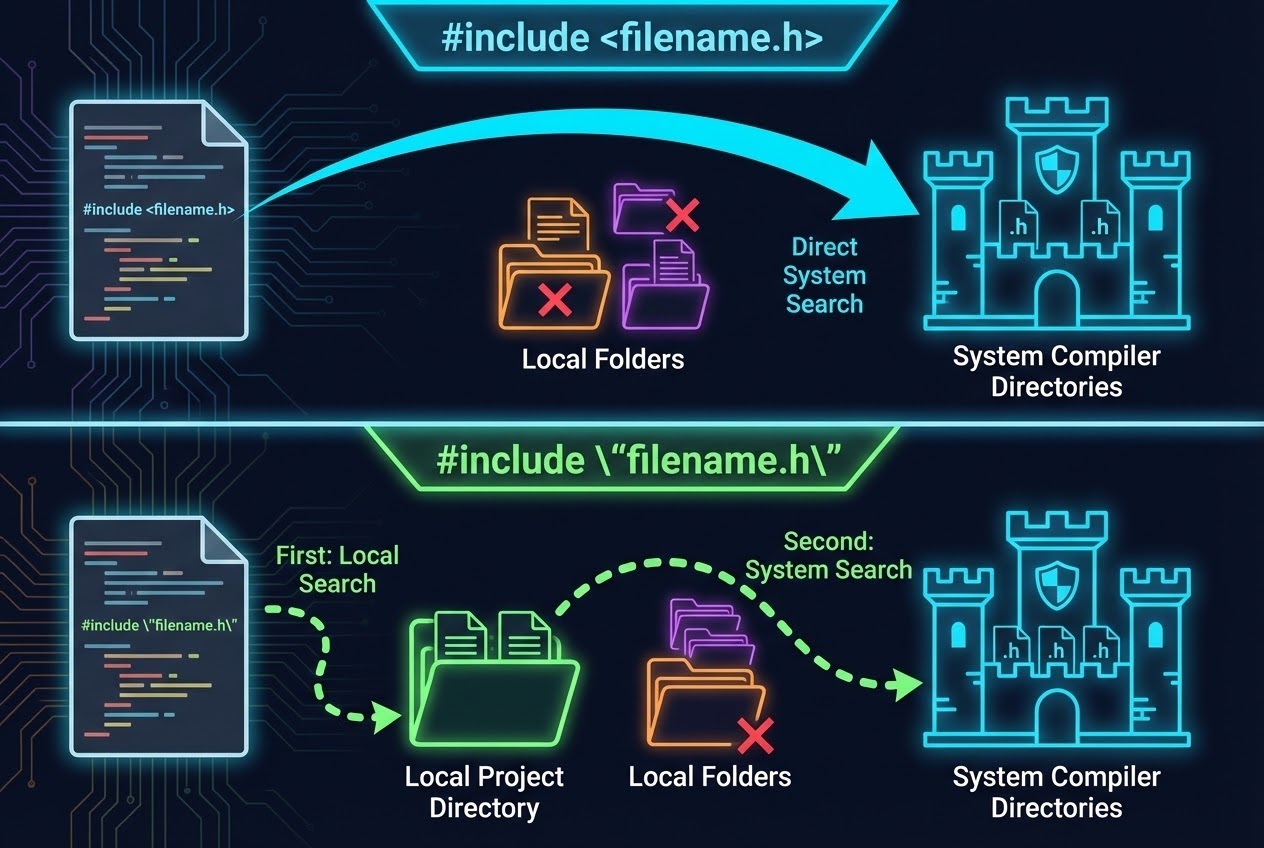
<>vs""): Have you actively scrutinized why global enterprise repositories frequently utilize angled brackets< >encapsulating file names, yet aggressively pivot utilizing double quotation marks" "elsewhere? These dual syntaxes dictate fundamentally different navigational search paths heavily impacting the compilation radar:#include <filename.h>: This syntax violently orders the Preprocessor to explicitly bypass local folders and immediately sprint interrogating the “Standard / System Directories (The Compiler’s primary internal library paths)” as its absolute first priority target. You deploy this exclusively hunting global standard libraries (e.g.,<stdio.h>,<stdint.h>) or downloading massive vendor-supplied silicon Register files explicitly bundled heavily within the Compiler toolkit.#include "filename.h": This specific directive forcefully commands the preprocessor scanner demanding it meticulously hunt tearing through the exact “Current Working Directory (The specific local folder housing your current project)” BEFORE checking anything else! If it spectacularly fails detecting the target locally, only then does it reluctantly escalate searching the global system directories. This geometry is entirely horizontally restricted exclusively targeting User-Defined Header files manually constructed by the active developer.
- 3. The Header File Anatomy: What Belongs Inside the Blueprint?:
Within the violent engineering culture of C development, we universally designate files carrying the
.hextension as the “Header Files.” They exist solely acting as the public diplomatic perimeter, broadcasting publicly “Shared” specifications outwards supplying neighboring modules. The absolute strictly legal elements permitted residing inside a Header file include:- Function Prototypes (Declarations): Aggressively shouting broadcasting to external files confirming that a specific function possessing exact parameter geometries physically exists somewhere in the universe!
- Configuration Logic: Erecting global constant values and hardware-level Definitions deploying aggressive
#defineMacros. - Architectural Blueprints: Forging rigid Data Structure templates (
struct) and stamping custom type definitions (typedef). - Global Target Pointers: Broadcasting hollow, ghostly references targeting external global data states explicitly utilizing the
externvariable tag.
- 4. The Quantum Dimension of Nested Includes (Include Chains):
Because the Preprocessor robot is engineered fundamentally possessing the capability to execute recursive infinite loops (Recursively), this directly implies that a target child Header file you actively
#includecan covertly house multiple internal#includedirectives buried deep inside its own geometry! Consequently, it acts dragging entire family trees of grandchild and great-grandchild Header files cascading assembling together erecting massive monolithic quantum structures! - 5. Heavy Artillery in C23 Architecture (
__has_include): Vaulting into the modern C standards specifications, elite architects finally granted us the tactical radar command__has_include. This enables developers to conditionally scan pinging the disk directory testing: “Does this mysterious theoretical Header file actually physically exist available for deployment?” BEFORE triggering the fatal command extracting it! This mechanism represents a monumental god-tier feature allowing developers dynamically hot-swapping routing cross-platform framework engines cleanly adapting between wildly different silicon vendors!
Firing Live Code Rounds: Bare-Metal Modular Architecture
Let us initiate a surgical breakdown constructing a highly functional architectural skeleton defining an exact Header file controlling a specialized hardware Sensor Module. We will immediately pair this observing exactly how the main.c commander file exploits the preprocessor establishing a flawless, Clean-Code modular link.
/* =========================================================================
 * FILE: sensor.h (The Public Diplomatic Blueprint broadcasting module specs)
 * ========================================================================= */

/* 🛡️ Strict Rule #1. The Include Guard: The impenetrable kinetic shield actively blocking catastrophic double-inclusion clone wars! */
#ifndef SENSOR_H_  /* IF the macro SENSOR_H_ remains undeclared within this specific compilation timeline... proceed! */
#define SENSOR_H_  /* IMMEDIATELY declare registering SENSOR_H_ destroying the timeline preventing any future execution! */

/* 2. Aggregate integrating required core System Headers actively guaranteeing this file operates completely Self-Sufficiently. */
#include <stdint.h>
#include <stdbool.h>

/* 3. Launching establishing aggressive Hardware-Level Constants and Macros. */
#define MAX_SENSOR_VALUE 1023
#define MIN_SENSOR_VALUE 0

/* 4. Forging the primary Architectural Blueprint (Data Structures) strictly defining local module objects. */
typedef struct {
    uint8_t id;               /* Hardware Sensor ID coordinate */
    uint16_t current_reading; /* Raw uncalibrated ADC conversion output data */
} SensorData_t;

/* 5. Broadcasting the public Function Prototypes (The brutal physical execution logic is violently hidden entirely inside sensor.c) */
void sensor_init(void);
bool sensor_read_data(SensorData_t *data_out);

#endif /* SENSOR_H_ Shield Perimeter Secure */
/* =========================================================================
 * FILE: main.c (The Primary Operations Command Center Source File)
 * ========================================================================= */

#include <stdio.h>      // Execute priority search targeting the internal Compiler System Directories.
#include "sensor.h"     // Execute priority search strictly scanning the active localized Project Directory!

int main(void) {
    /* Engage fabricating the Data Struct object parameter actively inheriting geometry explicitly from sensor.h! */
    SensorData_t my_sensor = { .id = 1, .current_reading = 0 };

    /* Fire execution command penetrating across files triggering the hardware GPIO initialization protocols. */
    sensor_init();

    /* Fire execution command extracting localized hardware data capturing the return payload directly into the memory pointer. */
    if (sensor_read_data(&my_sensor)) {
        printf("Real-time Sensor ID %d Update: %d\n", my_sensor.id, my_sensor.current_reading);
    }

    return 0;
}
Proximity Defcons: Violating the Forbidden Laws of C/C++ Architecture
Unlocking the raw manipulative power embedded inside the C Preprocessor and #include architecture grants developers magnificent god-like Modular structural capabilities. However, it perfectly mirrors a massive artillery cannon that can instantly violently reverse firing directly back destroying the compiler completely, triggering horrific phantom-level Linker Errors! Global master-class architectural institutions explicitly enforce the following survival mechanics:
- You Must Swear Absolute Loyalty Deploying Include Guards (Header Guards) Unconditionally!:
As your project repository violently mutates expanding into a colossal behemoth, your highly critical Header files will inevitably suffer the chaotic fate of being accidentally
#includedragged repeatedly crisscrossing simultaneously across a dozen intersecting dependency chains! The immediate fatal consequence is that as the robotic Preprocessor blindly copy-pastes dumping the identical text arrays rapidly, your exact identical Function Prototypes duplicate triplicating sequentially! The Compiler instantly panics violently screaming hurling extreme “Redefinition” fatal error anomalies completely halting operations! You are fiercely bound by engineering law to violently wrap deploying the magical protective spell#ifndef ... #define ... #endifentirely encapsulating the complete text payload vertically inside every single.hfile! This aggressively hypnotizes blocking the Preprocessor forcing it digesting that text payload successfully strictly “Exactly Once within the entire compilation universe timeline!” - Absolutely Never, Under Any Threat of Destruction, #include a
.cFile Extension!: This stands as the ultimate blood-oath architectural law governing the ancient texts of C programming! You are legally permitted exclusively#includeyanking specifically strictly Header (.h) extensions (which legally only house hollow Declarations / structural skeletons)! You must ABSOLUTELY NEVER arrogantly attempt#includetearing executing logic source payload files housing physical code (.c) bodies! Executing this savage action completely blinds the Compiler, which mechanically rips cloning the identical physical operational logic blocks, actively generating spawning precise duplicate copies across multiple separate object files globally! When the Linker executes attempting connecting the assembly targets, it suffers a total catastrophic operational failure, violently colliding detecting identical duplicate function identities existing everywhere triggering massive “Multiple Definition” critical kernel errors shattering the board! - Do Not Arrogantly Allocate Reserving Memory Variables inside a Header File:
Aggressively permanently burn this warning inside your Flash Memory: Within the boundary perimeters defining a Header file, you are heavily restricted permitted deploying solely “Hollow Notification Declarations (Blueprints)” ONLY! If you hopelessly blunder executing typing inserting a physical memory reservation
int my_super_var = 10;casually leaving it dropping it rotting inside a.hfile, you must brace for impact! The instant 5 separate neighboring files aggressively#includedownload that specific Header, they independently unknowingly clone generating allocating 5 entirely separate physical memory object variables identically branded fighting each other! State corruption is absolutely mathematically guaranteed! The explicit masterful maneuver commands: Heavily stamp inserting the ghost declaration blueprintextern int my_super_var;leaving it hovering visible inside the.hfile… Then immediately relocate dropping the actual brutal physical memory allocation parameterint my_super_var = 10;dropping it securely isolating burying it safely inside precisely one single specialized.csource file acting as the sole physical anchor! - Header Files Must Fiercely Execute Total Tactical Independence (Self-Sufficient Headers Objective):
Assume your primary Header file architecture is violently forced structurally dependent extracting the heavy Type definition
uint32_t. It absolutely must completely internally resolve that dependency! You must aggressively#include <stdint.h>proactively embedding installing that dependency violently locking it positioning it reigning supreme actively living inside the very top of your target Header File! Absolutely never display weak undisciplined architectural habits arrogantly expecting, demanding, or aggressively forcing external allied modules or team members holding them hostage demanding they blindly#include <stdint.h>sequentially blindly dropping it before attempting invoking calling down your Header file! This defines exceptionally toxic, utterly catastrophic embedded programming architecture completely shunned inside elite developer circles!
Conclusion
Plunging deep inside the brutal architectural conflict zone constituting the C Preprocessor, the seemingly mundane robotic worker-drone directive #include operates demonstrating catastrophic architectural leverage aggressively exceeding the simple pathetic act blindly linking random files together! It literally represents the pinnacle grandmaster mechanism defining “System Architecture!” We heavily armored super-engineers actively command this geometry perfectly erecting heavy structural boundaries explicitly isolating detaching “The published public interface payload we generously permit other modules activating (Interface / Header File Blueprint)” physically decoupling cleanly ripping it screaming away from “The classified internal hidden dungeon operating executing the brutal bloody processing logic (Implementation / C Source File Logic Layer)”!!! This identical geometric doctrine physically constructs the absolute backbone structural columns fundamentally supporting lifting erecting lower-level System Programming and the horrific colossal environments native within heavy industrial Embedded Systems architectures! It violently guarantees the payload survives extreme shock impacts blocking phantom bugs… concurrently entirely opening granting access allowing massive teams maintaining upgrading scaling adjusting fortifying executing target optimizations aggressively advancing forward decades later!
If the hardened veteran lead-smoke operatives aggressively tracking this transmission desire executing viewing heavy demonstrations aggressively networking integrating cross-platform scalable Header structures tunneling directly inside Master Library SDK silicon arrays, or simply heavily craving understanding the deep cosmic fatal architectural mystery regarding exactly why the terrifying extern "C" spell actively exists manipulating bypassing C++ compiling death sequences? Vertically descend initiating combat opening firing heavy discussion engagements dumping brilliant code frameworks battling directly conversing actively stationed deeply inside the core tactical development server at www.123microcontroller.com! Endlessly lock and load checking hardware configurations; we will establish aggressive visual contact dropping inside the next raw software architecture combat drop! Happy Embedded Coding, Logic Warriors!