C++ Functions Study Guide: From Basics to Advanced Techniques

C++ Functions Study Guide: Complete Reference
Functions are the fundamental building blocks of execution within a C++ program. Defining a function means specifying its exact task and behavior, while calling a function triggers that task into action. This guide covers essential concepts for developers, from basic declarations to advanced usage.
1. Function Declarations and Definitions
In C++, a function cannot be explicitly called unless it has been declared beforehand.
1.1 Function Declaration
A function declaration provides the compiler with the necessary information to permit a function call. It consists of:
- Name: The identifier of the function.
- Return Type: The type of value returned, or
voidif there is no return value. - Arguments: The number and types of parameters, specified within parentheses following the function name.
Examples of declarations:
double sqrt(double);    // Takes a double, returns a double
void exit(int);         // Takes an int, returns nothing
Elem* next_elem();      // Takes no arguments, returns a pointer to Elem
1.2 Function Definition
A function definition contains the actual code body that performs the work. Typically, to achieve separate compilation efficiency, declarations are placed in header files (.h or .hpp) and definitions in source files (.cpp).
Example of a definition:
double square(double x) // Definition of a function to calculate the square
{
    return x * x;
}
2. Argument Passing
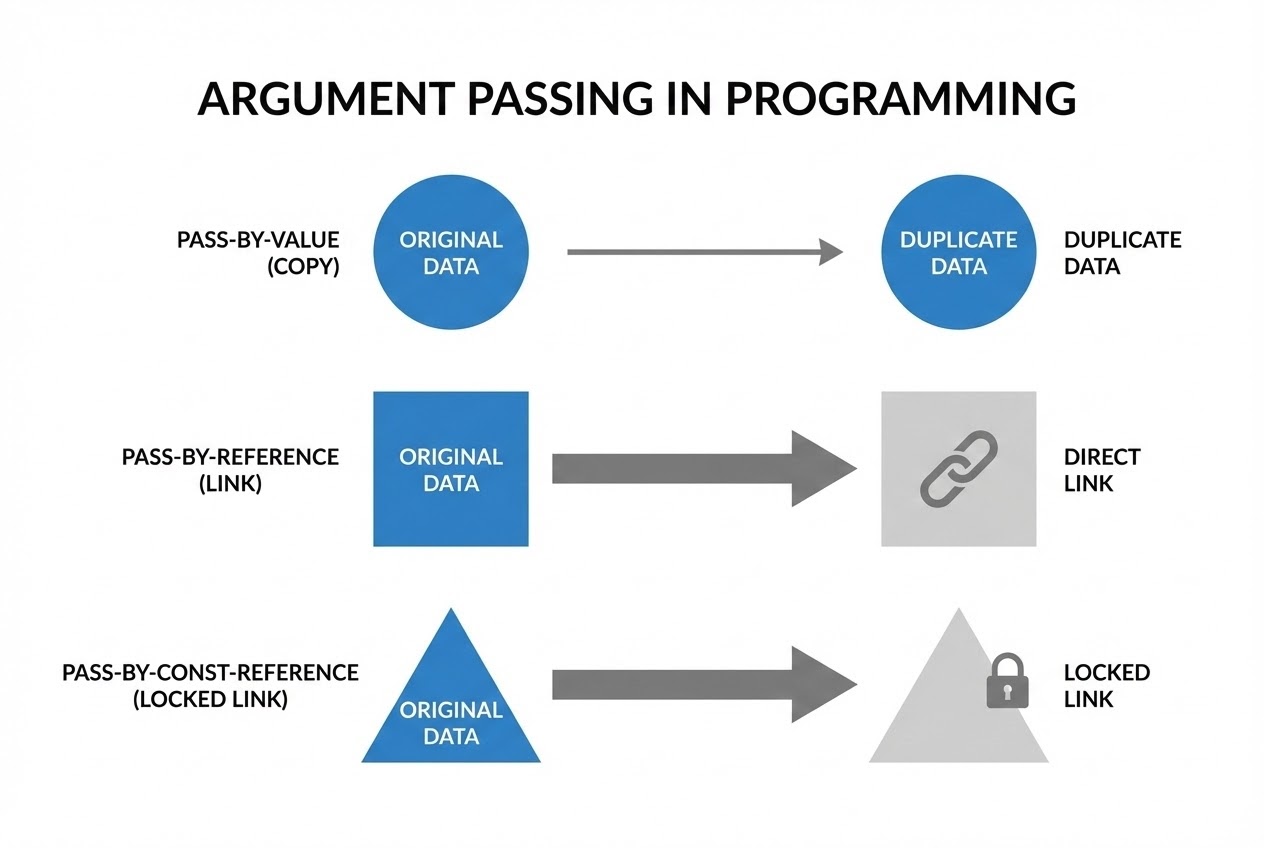
C++ offers multiple ways to pass data to functions, directly impacting performance and data safety.
| Method | Syntax | Description |
|---|---|---|
| Pass-by-value | T x |
Copies the original data into a local variable. Changes within the function do not affect the original. |
| Pass-by-reference | T& x |
The function operates directly on the original argument. No copying occurs. |
| Pass-by-const-reference | const T& x |
Shares the original data but prevents the function from modifying it. Ideal for large data types to maximize performance. |
Recommendations for Usage:
- Small Data: Use pass-by-value for small, cheap-to-copy types like
int,double, or pointers. - Large Data: Use pass-by-const-reference for larger objects like
std::vector<double>orstd::stringto avoid expensive copy costs. - Modifying Originals: Use pass-by-reference when the function intentionally needs to modify the caller’s variable.
3. Return Values
Functions can send results back to the caller via the return statement.
- Return-by-value: The standard method, suitable for small data types.
- Move Semantics: For returning large objects (like matrices or vectors), modern C++ leverages Move Constructors to efficiently transfer ownership without expensive copying operations.
- Return-type Deduction: Using
autoallows the compiler to deduce the return type. While convenient, use it judiciously so the function’s interface remains clear to other developers. - Structured Binding: Enables functions to return multiple values elegantly (often using
std::tupleor structs), allowing the caller to unpack the results directly into local variables.
4. Function Overloading
When multiple functions share the same name but differ in their argument types or counts, the compiler selects the most appropriate one during the call. This is known as Function Overloading.
Golden Rule: Overloaded functions should perform semantically equivalent operations. For example:
void print(int);     // Prints an integer
void print(double);  // Prints a floating-point number
void print(std::string);  // Prints a string
Note: If the compiler cannot definitively determine a single “best match” among the overloaded functions, it will generate an “Ambiguous Call” compilation error.
5. Special Function Types
5.1 constexpr Functions
Functions marked as constexpr tell the compiler to evaluate the result at compile-time if the provided arguments are constant expressions. This can significantly improve runtime efficiency.
- They must be simple and free of side effects.
- They behave as standard runtime functions if called with non-constant arguments.
5.2 Member Functions
These are functions defined within the scope of a class or struct.
- Constructors: Functions with the same name as the class, responsible for initializing an object upon creation.
constMember Functions: Indicated by theconstkeyword trailing the signature, guaranteeing the function will not modify the object’s internal state.
5.3 Virtual Functions
Crucial in class hierarchies to support runtime polymorphism. A function declared as virtual in a base class can be overridden by derived classes to provide specialized implementations.
6. Best Practices and Advice
- Keep it Short: Functions should be brief and do exactly one clearly defined task.
- Descriptive Naming: A function’s name should clearly articulate its purpose.
- Avoid Global Variables: Data should be passed into functions via arguments and extracted via return values. Global variables make code brittle and hard to test.
- Use
nullptr: Always usenullptrto represent a null pointer, abandoning the legacy0orNULLmacros. - Validate Pointers: If a function accepts a pointer, always verify it isn’t
nullptrbefore dereferencing it. - Static Assertions: If you have expectations about data types or sizes that should be true at compile-time, utilize
static_assertto enforce them and catch errors early.