Divide by Zero: Awakening the Undefined Behavior Demon in Embedded Systems

The Perils of Dividing by Zero in C
Hello fellow engineers and developers at 123microcontroller.com! Today, we are going to discuss a classic rule we learned back in elementary school: “Never divide by zero.”
In mathematics, dividing by zero is strictly “Undefined.” However, in the realm of C System Programming and microcontrollers, this rule is not just a mathematical curiosity. It is the trigger to an explosive hardware trap that opens the gateway to Undefined Behavior (UB). Today, we will dive deep into how global standards and experts view “Divide by Zero,” why it’s so dangerous, and how we can architect our hardware code to survive this deadly pitfall!
The Mechanics of Division by Zero in C
Division by zero in C is particularly fascinating because different hardware architectures and compilers respond to this problem in entirely different ways. Core safety standards explain the context of this issue as follows:
- Integer Division:
According to the C Standard (e.g., C99), it is explicitly stated that if the second operand (the divisor) of the
/(division) or%(modulus) operator is explicitly zero, the resulting behavior is instantly deemed Undefined Behavior!- Why doesn’t C check it for us?: The C language was architected to generate the maximum possible Machine Code efficiency with blistering speed. Compilers simply do not auto-inject Assembly code to check if a divisor is zero prior to calculating because doing so universally slows down execution. C adheres to the strict philosophy: “The programmer is entirely responsible.”
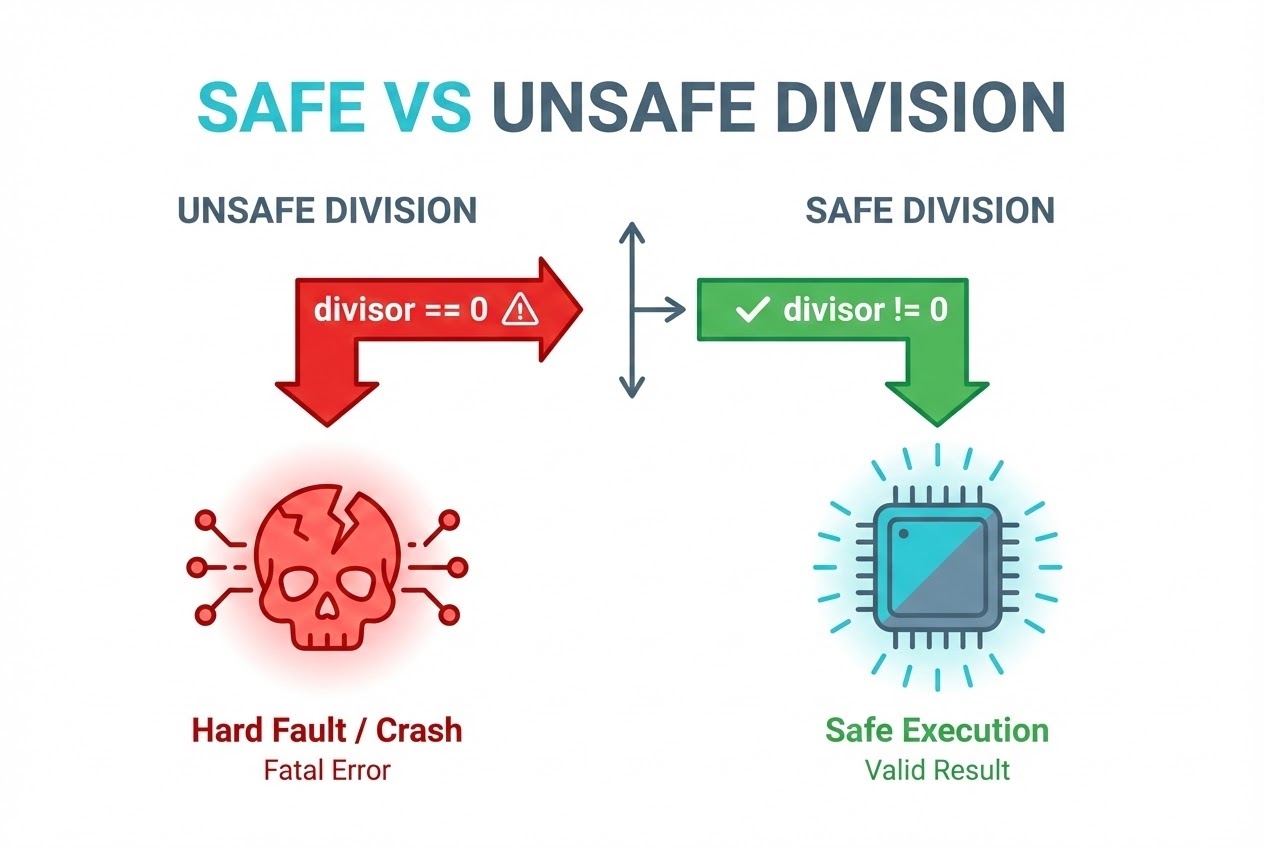
- Hardware Consequences: Integer division by zero usually results in a catastrophic Runtime Error that instantly crashes the program. For example, on ARM Cortex-M microchips (depending on Register configurations), it will generate a Hard Fault. This acts like ripping an emergency brake, freezing the system dead until a hardware Watchdog Timer resets the board. On environments like Linux (x86), the hardware emits a precise Hardware Exception signal known as
SIGFPE, which causes the operating system to forcefully terminate your application.
- Floating-Point Division:
Things are slightly more forgiving in this realm! If we evaluate variables formatted as
floatordouble, and our system natively supports the IEEE 754 floating-point standard, dividing by zero is typically NOT Undefined Behavior.- Dividing a positive floating number by zero yields a special value: +Infinity.
- Dividing a negative floating number by zero yields: -Infinity.
- Dividing strictly 0.0 by 0.0 yields: NaN (Not a Number), signifying the result is mathematically incalculable.
- While these specific operations allow the program code to continue progressing without an instant crash, the hardware typically sets a strict warning Flag (such as
FE_DIVBYZERO) that engineers must actively monitor and clear later.
C Code Example
Let’s explore a Clean Code example illustrating how to shield against the Nasal Demons caused by division by zero.
#include <stdio.h>
#include <stdbool.h>

/*
 * Safe Integer Division Function
 * Accepts dividend, divisor, and a Pointer to store the resulting quotient.
 * Returns true if successful, or false if an error occurred.
 */
bool safe_divide(int dividend, int divisor, int *quotient) {
    // 1. Prevent Null Pointer Dereference
    if (quotient == NULL) {
        return false;
    }

    // 2. Precondition Test: ALWAYS verify against Divide by Zero early!
    // This guards against both division by zero and Signed Integer Overflow (INT_MIN / -1)
    if (divisor == 0) {
        printf("Error: Attempt to divide by zero!\n");
        return false; // Safely halt the operation to protect the hardware
    }

    // 3. Perform the actual division ONLY after ensuring absolute safety
    *quotient = dividend / divisor;

    return true;
}

int main(void) {
    int sensor_sum = 1000;
    int sample_count = 0; // Assume we haven't successfully polled any sensors yet
    int average = 0;

    // Execute the safe division approach
    if (safe_divide(sensor_sum, sample_count, &average)) {
        printf("Average is %d\n", average);
    } else {
        // Implement Error handling: e.g., Set a default value or illuminate a Warning LED
        printf("Cannot calculate average yet.\n");
    }

    return 0;
}
Professional Best Practices
To prevent our Embedded systems from crashing mid-flight, rigorous global safety protocols like the SEI CERT C Coding Standard dictate clear, unbending rules:
- Strictly Follow Rule INT33-C: The standard dictates that you “Must ensure that division (
/) and remainder (%) operations do not result in divide-by-zero errors.” - Habitually Deploy Precondition Tests: Before subjecting any variable to become a divisor, rigorously inject an
if (divisor != 0)guard in front of it. This is hyper-critical if the value dynamically originates from User Input or external hardware Sensor data, as traditional functions simply cannot predict inbound spikes. - Beware the
%(Modulo) Operator: Many engineers expertly remember to check standard division (/), but fatally forget that utilizing the Modulo operator (%) with a zero divisor conjures the exact same destructive Undefined Behavior! - Activate Compiler Warnings: Forcefully enable the
-Wdiv-by-zeroflag (which is often a GCC default constraint). This commands the Compiler to actively bark warnings if you ever manually hardcode a constant zero denominator.
Conclusion
Divide by Zero is fundamentally not a minor glitch; it is a critical Runtime Logic Error where the C language actively delegates absolute freedom to the Compiler and random hardware quirks (Undefined Behavior). In the Embedded Systems hemisphere, where your circuits must run with rock-solid stability 24/7, permitting this error to slip by translates directly to stalled boards, corrupted mechanics, or invisible system crashes.
Burn into your memory: “Always interrogate your divisor prior to dividing!” Hopefully, this breakdown highly empowers you to architect much safer and vastly more resilient firmware. If you’re eager to master more defensive coding tricks or deep-dive into Secure Coding standards like a pro, definitely stop by and join the technical conversations at www.123microcontroller.com. See you in the next tutorial. Happy Coding!