Managing Locked Data: Understanding Constants, the Heart of Safe Code

The Power of Immutability in C++
Hello fellow developers and hardware hackers at 123microcontroller.com! Welcome back.
Imagine for a second that standard “Variables” are like a whiteboard—you can freely write, erase, and overwrite values anytime. “Constants,” on the other hand, are like words carved into a block of solid stone. Once etched, no one can ever erase or modify them.
In programming workflows, particularly when dealing with bare-metal hardware and microcontrollers, there are specific values that absolutely must never change during execution. Examples include the mathematical value of Pi (π), static GPIO pin assignments, or rigid memory buffer sizes. Today, we’re diving deep into the fundamentals of C++ Constants. We will explore how leveraging them correctly prevents catastrophic bugs, enforces strict Type Safety, and dramatically squeezes out runtime performance from our programs!
Core Concepts of Constants in C++
C++ documentation beautifully maps out the concept of “Constants” across several powerful dimensions:
- Say Goodbye to Magic Numbers: Hardcoding raw numbers directly into your logic (e.g.,
3.14159or100) is known as using “Magic Numbers.” It is a developer’s worst nightmare. If you ever need to update that value, you might struggle to find it or accidentally change the wrong instance. Naming these values as Constants makes your code highly readable and manageable from a single source of truth. - The
constKeyword (A Promise Not to Change): This is the fundamental keyword signaling to the Compiler that a variable is strictly “Read-only.” Once it has been initialized with a value, any subsequent code that attempts to mutate it will be immediately flagged as a hard Compiler Error. - Stop Using
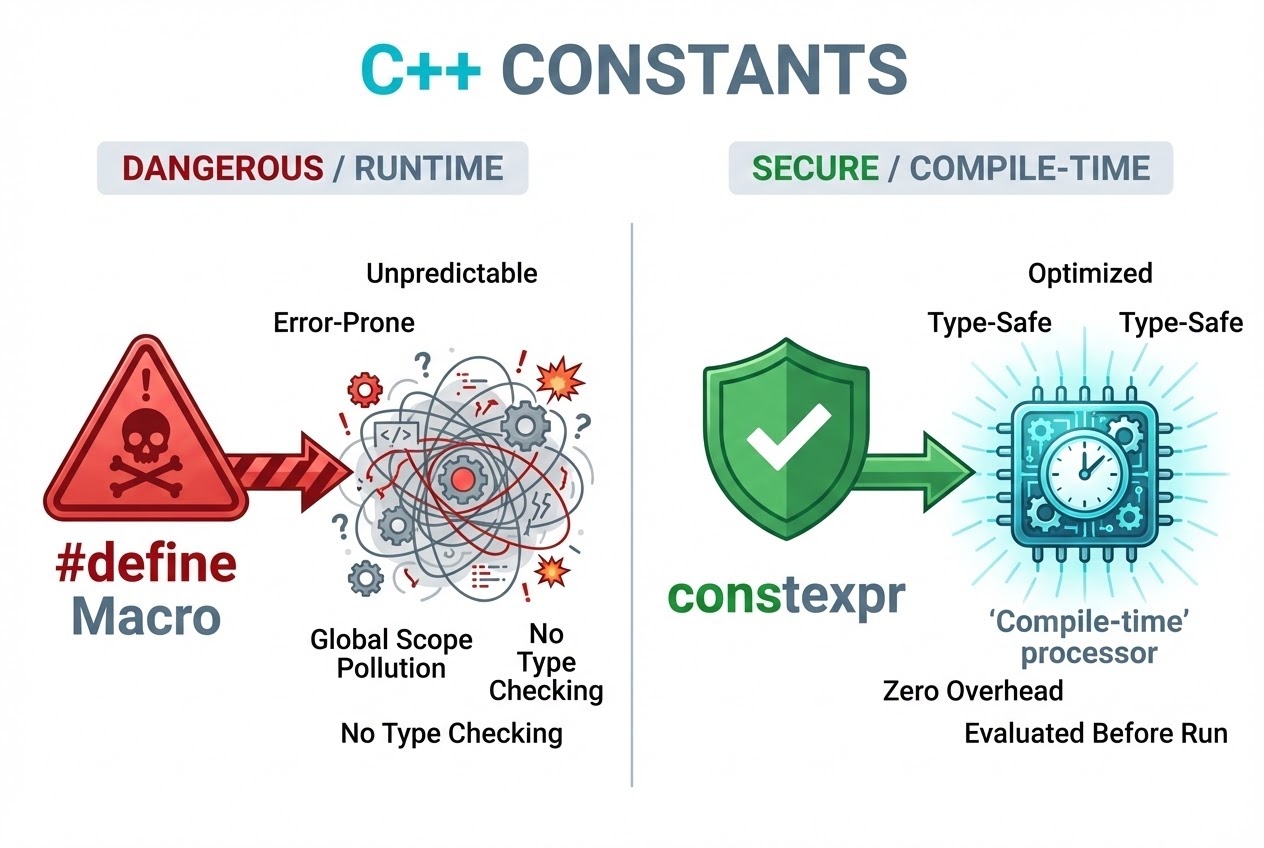
#defineMacros: In legacy C codebases, developers heavily relied on#define PI 3.14. This is simply a blind text replacement (Macro) performed by the Preprocessor. In modern C++, this is highly dangerous. Macros perform absolutely no type checking, they blatantly ignore Scope rules, and their names vanish inside a Debugger, making runtime bugs incredibly painful to track. constexpr(The Power of Pre-computation): Modern C++ (C++11 and later) introducedconstexpr, elevating constants to a whole new level. This keyword strictly forces the Compiler to fully evaluate and compute the value during the Compile-time phase. This guarantees that absolutely zero calculation burden is left for the program to handle during Runtime. This results in lightning-fast execution, making it a critical tool for Embedded Systems and microcontrollers!- Mathematical Constants in C++20: As of C++20, we successfully retired the need to manually define constants like Pi or Euler’s number (e). C++ introduced the
<numbers>library header, fully equipped with high-precision, ready-to-use constants likestd::numbers::piandstd::numbers::e.
Clean Code Example
Let’s look at a pristine Modern C++ example showcasing proper, clean, and safe constant usage:
#include <iostream>
#include <numbers> // Used to invoke standard mathematical constants (C++20)

// ❌ NOT RECOMMENDED: The dangerous, legacy C-style Macro
#define OLD_MAX_BUFFER 1024

// ✅ HIGHLY RECOMMENDED: Using constexpr for values known flawlessly at Compile-time
constexpr int MAX_BUFFER { 1024 };

// A constexpr function can fully pre-calculate its result during Compile-time!
constexpr double calculateCircleArea(double radius) {
    // Leveraging the ultra-precise Pi from the C++20 Standard Library
    return std::numbers::pi * radius * radius;
}

int main() {
    // We force the Compiler to calculate the area for a radius of 5.0 before the program even runs
    constexpr double areaOfCircle = calculateCircleArea(5.0);

    // Using 'const' for a value that might only be acquired during Runtime
    // but needs to be rigorously locked from modifications thereafter.
    int userInput = 10; // For example, simulating dynamic input from a sensor or user
    const int fixedInput = userInput;

    // fixedInput = 20; // ❌ The Compiler will aggressively throw an Error if we attempt this

    std::cout << "Max Buffer Size: " << MAX_BUFFER << "\n";
    std::cout << "Circle Area: " << areaOfCircle << "\n";

    return 0;
}
Professional Best Practices
Drawing from secure coding standardizations like SEI CERT C++ and the official C++ Core Guidelines, here are the crucial takeaways for writing bulletproof logic:
- Make
constexprYour Default: If a constant value can be evaluated at Compile-time, heavily bias towards usingconstexproverconst. This aggressively aids the Compiler in optimizing your code’s memory footprint and speed to the absolute maximum. - A
constVariable Must Be Initialized Immediately: You legally cannot declare a floatingconst int x;without assigning a value to it. Because it is a permanent lock, you never get a second chance to inject a value into it later down the line. - Always Pass by Reference-to-const (
const T&): Whenever you are passing large data structures (like complex Objects or extensive Classes) into generic functions, consistently pass them as aconst T&. This brilliant mechanic bypasses aggressive Performance overheads caused by data copying, while simultaneously guaranteeing the receiving function cannot mutate your precious original data.
Conclusion
To briefly summarize: Constants are not merely labels acting as substitutes for numeric values. They are highly expressive “communication tools” signaling to both your teammates and the Compiler that a specific piece of data is absolutely critical and universally immutable. Comprehending the refined difference between const (a lock preventing change) and constexpr (aggressively forcing compile-time pre-calculation) will massively elevate your C++ code. Your firmware will become professional, blindingly fast, and immune to crippling mutation bugs!
If you enjoyed absorbing this concept and want to deploy blindingly fast, ultra-safe logic onto actual microcontroller hardware, head straight over to www.123microcontroller.com for more immersive projects and C++ tricks. Happy Coding!