Commenting Practices & Doxygen: The Art of Commenting to Elevate Safer C
Introduction: Why Comments Are More Than Just Scratchpads
Hello engineers and fellow developers at www.123microcontroller.com! Today, the dark-eyed engineer is here to talk about a topic that many developers tend to overlook: “Writing Comments.”
In the demanding world of hardware and Embedded Systems, the code we write today might be maintained or debugged by a junior developer five years from now. Writing comments isn’t mere note-taking; in the context of Writing Safer C, comments act as the “manual and blueprint”. They exist to prevent team members (or even yourself) from completely misunderstanding the logic and accidentally breaking the firmware! Furthermore, today we will introduce you to Doxygen—an industry-standard tool that automatically transforms your plain text comments into luxurious, highly readable documentation.
The Code Blueprint and the Doxygen Standard
When discussing Writing Safer C, top-tier engineering resources place massive emphasis on effective commenting. Here are the core philosophies:
- Doxygen: The De Facto Standard:
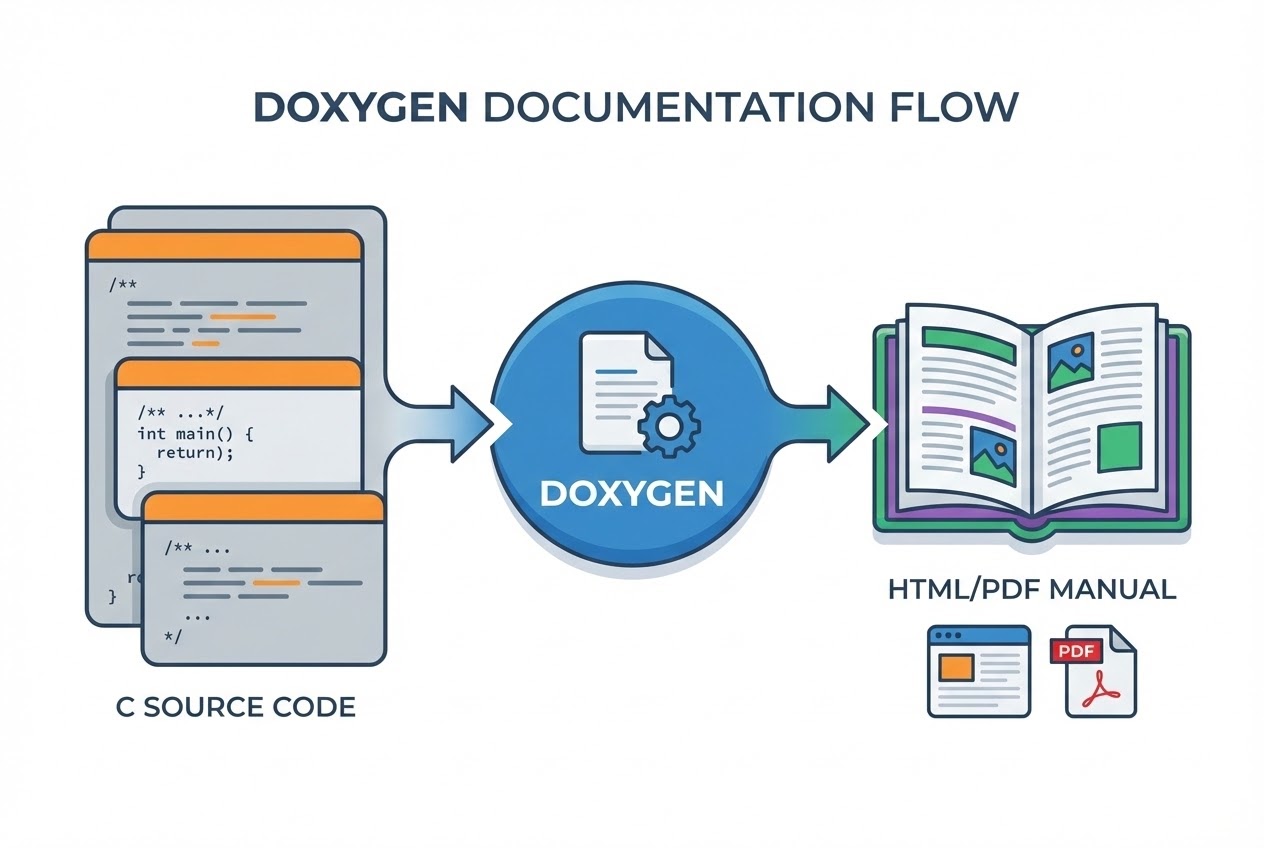
Unlike modern languages, standard C lacks a built-in, native documentation tool format. However, the hardware engineering industry universally embraces Doxygen as the De facto standard. It functions like a personal secretary, parsing code for specially formatted comments (e.g., lines starting with
/**) and automatically generating beautiful HTML web pages, PDF manuals, and even architectural Dependency and Call trees. - Separating Interface from Implementation:
The golden rule of clean commenting is drastically separating the roles of Header files (
.h) and Source files (.c):- Interface (in
.h): Utilize Doxygen specifically here to describe “What is done” by the function, the purpose of its parameters, and the nature of its return values. - Implementation (in
.c): Code natively shows us “how it works.” Thus, comments buried inside the function body should focus purely on the “Manner/Purpose”—explaining why a particular engineering decision or hack was made.
- Interface (in
- Comments Prevent Long-Term Bugs: Adhering strictly to the principle of “keeping documentation as close to the code as possible” severely reduces maintenance overhead. More importantly, it nearly eliminates the risk of standalone manuals drifting out of sync with the actual source code over time.
Code Example: Clean Comments using Doxygen Style
Let’s look at a prime example of writing clean, safe, Doxygen-compliant comments within a C Header file.
#include <stdint.h>
#include <stdbool.h>

/**
 * @brief Sets the motor target speed via hardware PWM.
 *
 * Modifies the main motor's speed output by directly interfacing with the
 * hardware Timer peripheral to adjust the Duty Cycle.
 *
 * @param speed_percent Desired target speed in percentage (0 to 100).
 *                      Values exceeding 100 are automatically clamped to 100.
 * @param is_forward    Rotation direction: true = forward, false = reverse.
 *
 * @return Returns true if hardware was successfully configured, false if hardware busy.
 */
bool motor_set_speed(uint8_t speed_percent, bool is_forward);

int main(void) {
    /*
     * ❌ DANGER: Nested Comments Vulnerability!
     * Failing to close a block comment or nesting `/*`
     * can cause critical functions like safety_checker() to be entirely ignored by the compiler!
     */
    /* The following code was meant to be part of the build...
    motor_set_speed(50, true);

    /* Silent Bug! The line below will never execute! */
    safety_checker();

    return 0;
}
Pitfalls and Professional Commenting Practices
To prevent your comments from becoming the root cause of new bugs, follow these industry Best Practices:
- Beware the Catastrophe of Nested Comments: This is a classic, catastrophic flaw in C programming! Utilizing standard
/* ... */block comments over large sections is extremely dangerous, as nested blocks confuse the compiler, causing it to blindly skip crucial safety checks. If you need to temporarily disable large blocks of code (“comment out”), it is infinitely safer to use Conditional Compilation, such as#if 0 ... #endifor#ifndef NDEBUG. - Outdated Comments Are Worse Than No Comments: The absolute rule is: Whenever code logic changes, you MUST update the comment simultaneously. A wrong, outdated comment behaves like an active sabotager, actively deceiving other developers and inducing severe logical errors.
- Compiler Ignorance: Remember that during the compilation phase, virtually all comments are completely stripped away. They have exactly zero impact on flash memory size, RAM usage, or execution speed. Therefore, never be terrified of writing highly detailed, crystal-clear comments!
- Audit Comments During Code Review: The quality of comments should be violently scrutinized during Code Reviews alongside the actual logic. Ensure the documentation is concise, unambiguous, and genuinely adds engineering value to the person adopting the codebase next.
Conclusion
In the demanding ecosystem of Writing Safer C, commenting is not a tedious chore; it’s the act of continuously “injecting immunity” into our projects. Leveraging world-class automated tools like Doxygen and maintaining fierce discipline regarding documentation updates guarantees that the hardware behaves exactly as you (and your team) meticulously engineered it to.
If you’re eager to see a tutorial on finely tuning a Doxyfile or want to deep dive into more professional microcontroller programming methodologies, be sure to keep following and discussing on www.123microcontroller.com. See you in the coming articles. Happy Coding, everyone!