Compiler Wars: The Hidden Differences and the Ultimate Challenge for C Engineers

Compiler Wars: The Hidden Differences in C
Hello embedded engineers and developers of the 123microcontroller community! Welcome back to another deep dive into the world of system programming.
Many of you might have experienced this frustrating scenario: You write a C program, compile it, and it runs perfectly on your PC. But the moment you compile that exact same code using a Cross-compiler to flash it onto a microcontroller, it behaves erratically, throws bizarre bugs, or simply refuses to compile at all!
Why does this happen? The answer lies in “Compiler Differences.” To put it simply, compilers are like chefs. Even if every chef is given the exact same recipe book (the ISO C Standard), each chef has their own unique techniques, pans, and interpretations of the recipe. In the context of global software challenges, the discrepancies between compilers create massive headaches for developers. Today, we’re going to explore why merely saying “I know C” isn’t enough if you don’t deeply understand the compiler you are using. Let’s dive in!
The Challenge of Compiler Diversity
In the broader context of C programming challenges, software architecture experts summarize the root causes of compiler differences as follows:
1. The Standard’s Loopholes (Implementation-Defined Behaviors)
The ISO C Standard does not define every single detail with 100% rigidity. It intentionally leaves “loopholes” known as Implementation-defined behaviors. This allows compiler vendors to optimize code execution for specific hardware architectures. As a result, identical source code compiled with different compilers might exhibit completely different run-time behaviors. A classic example is the size of an int type or the number of bits in a byte—the standard does not mandate a fixed size!
2. Aggressive Optimization and Undefined Behavior (UB)
Modern compilers are incredibly smart and aggressive in squeezing out maximum performance. When a compiler encounters what the standard calls an Undefined Behavior (like dividing by zero, or accessing an array out of bounds), it is legally allowed to do whatever it wants. One compiler might ignore it, while another might completely strip away that chunk of code (Aggressive optimization), fundamentally changing the program’s logic.
3. The Standard Lag
The C standard is continuously updated (C99, C11, C17, C23). However, in reality, compiler vendors take years to fully support new standards. Furthermore, some embedded compiler vendors choose to stop active development or only implement partial support. Therefore, an engineer cannot blindly assume that a modern feature (like _Bool or Variable Length Arrays) will be supported across all compilers.
4. Vendor Extensions
To make life easier for hardware programmers, compiler vendors (like GCC, Clang, CCS, Keil) often introduce custom syntax that does not exist in the ISO C standard. For instance, standard C has no concept of hardware interrupts. Therefore, every compiler has a wildly different way of declaring an Interrupt Service Routine (ISR) or using weird keywords like rom or xdata to specify memory regions. This causes Vendor Lock-in, making it extremely painful to port your firmware to a different chip.
5. Embedded World Limitations
While PC compilers come with a massive, fully-featured standard library, compilers built for resource-constrained microcontrollers often strip out heavy functions. You might find that printf is missing, or dynamic memory allocation (malloc) is entirely unsupported. Code relying on these functions will immediately break when ported to an embedded platform.
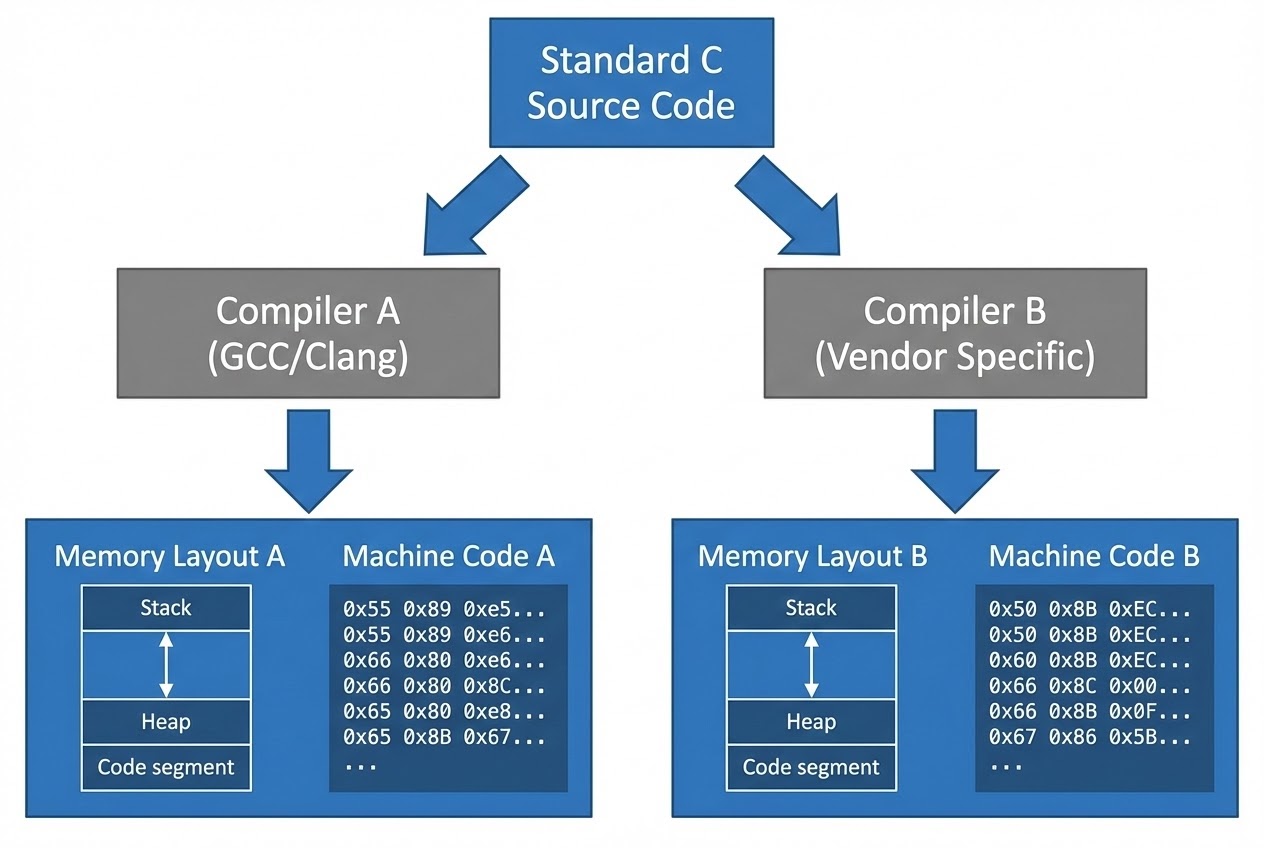
Code Example: Taming Compiler Differences
Professional system engineers never assume their code will automatically run anywhere. Instead, we use the C Preprocessor and Standard Headers to build a defensive shield.
#include <stdio.h>
/* 🛡️ Always use <stdint.h> to solve the varying variable size problem across compilers */
#include <stdint.h>

/* ======================================================================
 * Using #ifdef to handle Compiler Extensions gracefully
 * ====================================================================== */
#if defined(__GNUC__) || defined(__clang__)
    /* For GCC/Clang, use attributes to prevent aggressive optimization */
    #define NO_INLINE __attribute__((noinline))
#elif defined(_MSC_VER)
    /* Microsoft Visual C++ uses a completely different syntax */
    #define NO_INLINE __declspec(noinline)
#else
    /* For unknown compilers, define as empty to prevent syntax errors */
    #define NO_INLINE
#endif

/* ======================================================================
 * Guarding against outdated compiler standards
 * ====================================================================== */
#if __STDC_VERSION__ < 199901L
    #error "This code requires at least a C99 compliant compiler!"
#endif

NO_INLINE void process_sensor_data(uint32_t sensor_val) {
    /* We are 100% sure sensor_val is exactly 32 bits, regardless of the compiler's native 'int' size */
    printf("Processing data: %u\n", sensor_val);
}

int main(void) {
    process_sensor_data(0xFFFFFFFF);
    return 0;
}
Best Practices & Defenses
To overcome the challenges of compiler discrepancies, global experts recommend the following defensive strategies:
- Know Your Tools: Never assume you know C perfectly. Nobody memorizes every edge case. Beyond reading C textbooks, you must read the specific manual of the compiler you are using to understand its quirks, extensions, and limitations.
- Adopt Safe Sub-sets: Because the C standard is so dangerously flexible, mission-critical industries (like automotive and aerospace) enforce strict sub-sets like MISRA C or BARR-C. Following these rules keeps you away from “gray areas,” ensuring your code is stable and portable across any compiler.
- Maximize Compiler Warnings: Despite their differences, all compilers share one great trait: they are excellent bug-detectors. Always turn your warning levels to the maximum (e.g.,
-Wall -Wextrain GCC/Clang) and treat every warning as an error that must be fixed. - Avoid Conditional Compilation Spaghetti: While using
#ifdefto support multiple compilers and boards is good, overusing it makes your code bloated and unreadable. Isolate compiler-specific and hardware-specific code into separate, clean files known as a Hardware Abstraction Layer (HAL).
Conclusion
The true challenge of C programming isn’t just memorizing syntax or mastering pointers. It’s managing the “dangerous flexibility” of the language standard, which gives every compiler the freedom to creatively construct (or aggressively destroy) your code. Deeply understanding your compiler is the key to writing firmware that is robust, highly portable, and behaves exactly as intended 100% of the time.
Have you ever encountered a phantom bug caused by upgrading a compiler version, or pulled your hair out setting up a cross-compiler for a new MCU board? Drop by and share your frustrations and techniques on our community board at www.123microcontroller.com! See you in the next article. Happy Coding!