Decoding C Variable Declarations: The Foundation of Memory Allocation in the Bare-Metal World

Decoding C Variable Declarations: The Foundation of Memory Allocation
Hello embedded engineers and developers of the 123microcontroller community! Welcome back to another deep dive into the core of C programming.
When we start writing firmware for a microcontroller, before we can toggle any I/O pin, we must first configure its hardware register as an Input or Output, right? The software world operates on a similar principle. Before we can use any variable, we must introduce it to the compiler through a process called “Declaration”.
In C programming, declaring a variable isn’t just about giving it a fancy name. It is a strict contract with the compiler that states: “I am requesting this specific amount of memory allocation,” and “Here is how you should interpret the data residing at that RAM address.” Today, we are going to decode the anatomy of variable declarations according to the C standard, laying a rock-solid foundation for your embedded code. Let’s dive in!
The Anatomy and Fundamentals of a Declaration
At a structural level, a standard C program consists of “Functions” and “Declarations.” Declarations describe the characteristics of functions and the types of data that will be manipulated. Expert system programmers break down the mechanics of declarations as follows:
1. Basic Syntax
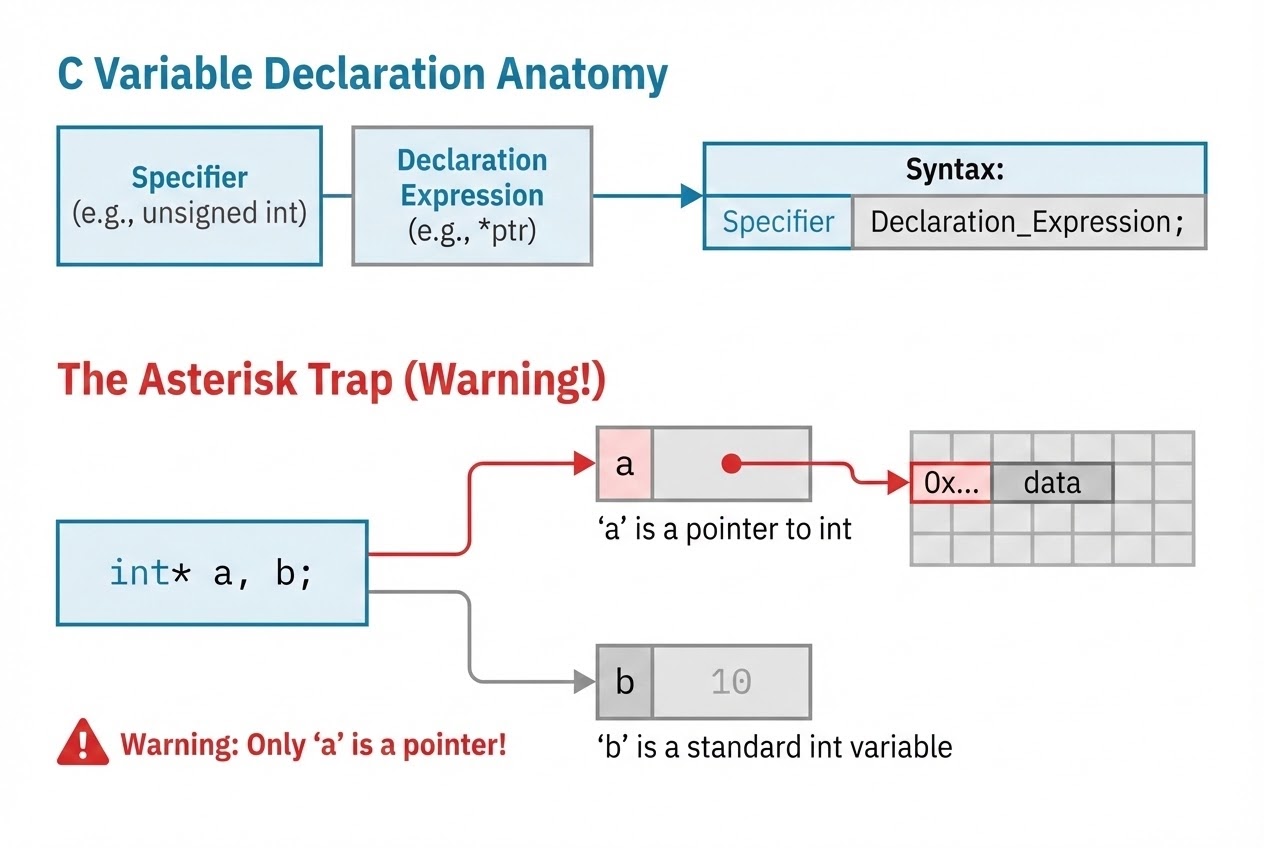
The most fundamental form of a variable declaration is: specifier(s) declaration_expression_list
- Specifier(s): These are keywords defining the base data type (e.g.,
int,char,float) and modifiers that alter its properties (e.g.,signed,unsigned,short,long,volatile). - Declaration Expression List: For standard variables, this is simply a list of names. But for complex types (like pointers or arrays), it is an expression that dictates how the variable will be used.
2. Declaration by Inference
This is where C diverges significantly from languages like Pascal! C declares variables based on how they are used. For example, when declaring a pointer:
int *a;
The compiler interprets this as: “If the expression *a is evaluated (dereferenced), the resulting value will be of type int.” From this, we must logically infer that the variable a itself must be a pointer to an int.
3. The Asterisk Trap
Because C is a free-form language, many programmers casually write code with spacing like this: int* b, c, d;. They mistakenly believe this declares all three variables as pointers. This is a dangerous misconception! The asterisk (*) is part of the declaration expression bound only to the first variable. Thus, only b is a pointer, while c and d are just standard int variables. The correct syntax for declaring three pointers is: int *b, *c, *d;.
4. Reading Complex Declarations (Right-to-Left)
When encountering complex declarations mixed with keywords like const, experts recommend the “Read Backward” (Right-to-Left) technique. For example, const int *pci; should be read from right to left as: pci is a pointer (*) to an integer (int) that is constant (const).
5. Using typedef to Create New Type Names
We can use the typedef keyword before a declaration to transform the variable name into a “new data type name” rather than an actual variable. Using typedef significantly reduces errors when declaring complex variables (like function pointers or structs) and makes future code refactoring much easier.
Code Example: Clean Declarations in Embedded C
Let’s look at a practical example demonstrating clean, embedded-style variable and pointer declarations.
#include <stdio.h>
#include <stdint.h>

/*
 * 1. Using typedef (Best Practice)
 * Creating a new data type named 'PINT' which stands for "Pointer to int".
 * This is vastly safer than using #define when declaring multiple variables on one line.
 */
typedef int* PINT;

int main(void) {
    /* 2. Standard variable declaration and initialization */
    int sensor_val = 100;

    /*
     * 3. Pointer declaration
     * Notice we attach the * to the variable name to prevent confusion.
     * We also initialize it immediately.
     */
    int *ptr_sensor = &sensor_val;

    /*
     * 4. Declaring multiple pointers on a single line
     * Method 1: You must prefix every variable with an asterisk.
     */
    int *ptr1, *ptr2;

    /*
     * Method 2: Using our custom typedef.
     * Both ptr3 and ptr4 are now safely declared as pointers.
     */
    PINT ptr3, ptr4;

    /* Utilization */
    ptr1 = ptr_sensor;
    printf("Sensor Value: %d\n", *ptr1);

    return 0;
}
Best Practices & Hidden Dangers
A declaration is the birthplace of your program’s data, but it is also a breeding ground for low-level bugs. Secure Coding guidelines warn against the following pitfalls:
- Wild Pointers & Uninitialized Variables: When you declare a local variable (automatic storage class on the Stack) without initializing it, it does not default to zero. It contains lingering “Garbage” data. If that variable is a pointer (a Wild Pointer), dereferencing it will cause your program to read or overwrite random memory, usually resulting in a fatal Segmentation Fault. Fix: Always initialize variables. If a pointer has no target yet, assign it to
NULL. - The Danger of
#definefor Pointer Types: Never use#define PINT int*to create a new type! If you declarePINT a, b;, the Preprocessor will blindly expand it toint* a, b;, makingaa pointer andba standard integer. Fix: Always usetypedefas shown in the code example. - Never Rely on Implicit Declarations: In ancient C (K&R C), if you declared a variable or function without specifying its type, the compiler implicitly assumed it was an
int. Modern standards (C99 and above) consider this highly dangerous. Implicit typing leads to disastrous bugs, especially when dealing with floating-point math or pointers. Always explicitly state your data types!
Conclusion
Variable Declarations are not just boring syntax rules; they are micro-architectural blueprints that tell the compiler: “Here is a chunk of memory, and this is exactly how you must process it.” Grasping mechanics like Declaration by Inference and the Right-to-Left reading technique will drastically simplify your life when you encounter complex structures like Pointers to Functions or Arrays of Pointers in advanced C code.
Has anyone here ever been tricked by the int* a, b; bug? (I once lost half a day debugging that exact issue! 😅). Don’t forget to drop by, share your experiences, and discuss code on our community board at www.123microcontroller.com! See you in the next article. Happy Coding!