The Epic Saga of C Standards (K&R to C23): When Backward Compatibility Becomes the Ultimate Hardware Challenge

The Epic Saga of C Standards (K&R to C23)
Hello embedded engineers and developers of the 123microcontroller community! Welcome back to another deep dive into the core of system programming.
Whenever we say, “I can write in C,” veteran engineers will often fire back with a sharp question: “Which version of C?” Many beginners assume C is just C, uniform across the board. But in reality, the C programming language is over 40 years old and has evolved through multiple eras of “Standards”—from K&R and C89, through C99 and C11, all the way to the modern C23.
The ultimate headache for the C Standards Committee has always been maintaining “Backward Compatibility” so that decades-old code doesn’t suddenly break. However, this commitment has spawned layers of complexity, legacy baggage, and countless Undefined Behaviors (UB). Today, we’re going to dissect how this standard evolution impacts the world of System Programming and Embedded Systems. Let’s dive in!
The Evolution of C Standards and Hidden Challenges
In the broader context of C programming, software architecture experts outline the standard evolution and its inherent challenges as follows:
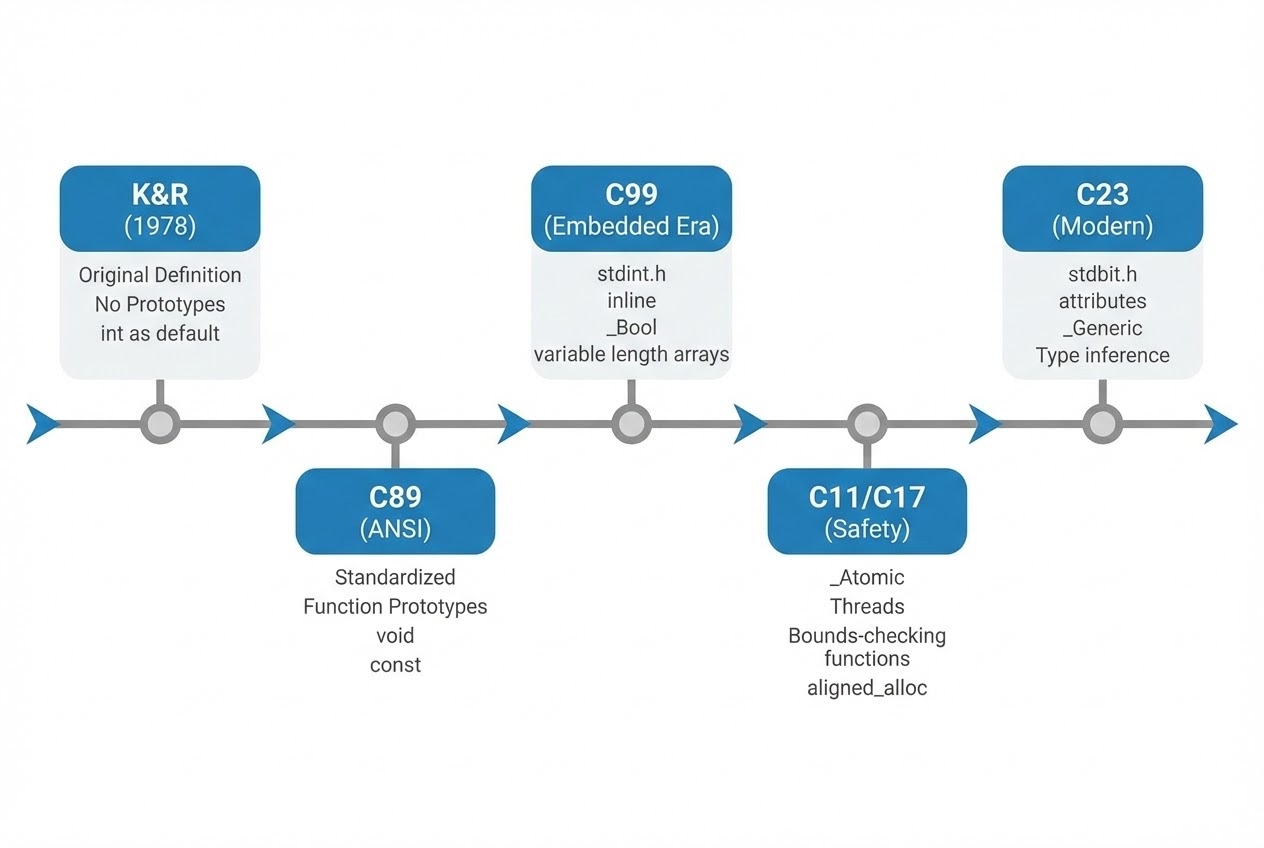
1. The Pioneer Era: K&R C (1978) - Freedom and Chaos
In the beginning, C had no official standard. The C Programming Language book by Brian Kernighan and Dennis Ritchie served as the de facto standard. The philosophy was simple: “Trust the programmer.” However, the rules were ambiguous, leading compiler vendors to interpret them differently and create weird “dialects.” Worse, function declarations didn’t require parameter types, meaning the compiler couldn’t perform type checking, leading to disastrous runtime bugs.
2. The Standardization: ANSI C / C89 (1989) - The First Law
As C was ported across wildly different hardware architectures, code became highly unportable. Organizations like ANSI and ISO stepped in to publish C89 (or C90). This was a major turning point for hardware developers, introducing critical keywords like volatile, const, and void, while officially enforcing Function Prototypes.
3. The Embedded Era: C99 (1999) - A Friend to Hardware
C99 brought features that microcontroller developers absolutely loved. It introduced <stdint.h>, allowing us to define exact-width integers (like uint32_t) instead of guessing the size of an int. It also brought // comments, inline functions, and variable declarations inside for loops. The challenge? Compiler adoption was notoriously slow, making cross-platform porting frustrating.
4. The Safety Era: C11, C17/C18 (2011-2018) - Stepping Back to Move Forward
The committee realized that C99 wasn’t fully embraced by compiler vendors, especially in the small embedded market. C11 compromised by making some C99 features “optional.” However, C11 introduced multithreading libraries and attempted to patch security holes. C18 followed later with no new features—it was essentially a massive bug-fix release for C11.
5. The Modern Future: C23 (2024) - Breaking the Legacy
This is a profound update! C23 officially “Removes” old K&R-style function declarations entirely (introducing breaking changes for legacy code bases). It also embraces the hardware layer heavily by introducing headers like <stdbit.h> for standardized bit manipulation.
⚡ The Real Challenge
C developers must survive in a “Constantly changing language.” The standard intentionally leaves many areas as “Implementation-defined” or “Undefined Behavior (UB)” to allow compilers to optimize code aggressively for specific silicon. The result? The exact same code might behave entirely differently when compiled with GCC vs. Clang, or even just by switching from -O0 to -O2! This is the ultimate nightmare for mission-critical embedded systems.
Code Example: Handling Standard Diversity
A robust software engineer never guesses the compiler standard. Instead, we use preprocessor directives to enforce standards and use <stdint.h> for cross-platform safety.
#include <stdio.h>
#include <stdlib.h>

/*
 * 1. 🛡️ Check if the compiler meets at least the C99 standard.
 * The __STDC_VERSION__ macro is defined by standard-compliant compilers.
 */
#if defined(__STDC_VERSION__) && __STDC_VERSION__ >= 199901L
    /* If C99 or newer, we can safely use Fixed-width integers. */
    #include <stdint.h>
    #include <stdbool.h>
#else
    /* If C89 or older, halt compilation and throw an error. */
    #error "This firmware requires a C99 or newer compiler! Please use -std=c99"
#endif

/*
 * 2. ❌ Legacy K&R C Style (DO NOT USE!)
 * This lacks strict type checking and will cause a build break in C23.
 */
/*
int old_style_hardware_init(port, value)
    int port;
    int value;
{
    return 1;
}
*/

/*
 * 3. ✅ Modern C Style (C99 and beyond)
 * Strict prototypes and exact-width integers are mandatory for hardware manipulation.
 */
bool modern_hardware_init(uint32_t port_address, uint8_t initial_value) {
    volatile uint8_t *hw_port = (uint8_t *)port_address;
    *hw_port = initial_value;
    return true;
}

int main(void) { /* 'void' explicitly declares no parameters, standard since C89 */
    if(modern_hardware_init(0x40021000, 0xFF)) {
        printf("Hardware Initialized using Modern C standards.\n");
    }
    return EXIT_SUCCESS;
}
Best Practices & Hidden Pitfalls
Navigating the minefield of C standards requires discipline. Secure coding guidelines like SEI CERT C and MISRA C recommend the following rules:
- Enforce Standards via Compiler Flags: Don’t let the IDE or compiler choose the standard silently. If using GCC/Clang, explicitly define the flag (e.g.,
-std=c99or-std=c11). Always enable aggressive warnings with-Wall -Wextra -Werror. - Eradicate Legacy Structures (DCL Rules): Never write K&R style function declarations without parameter types. It disables the compiler’s ability to catch signature mismatches, and starting with C23, your code will fail to compile altogether.
- Beware of Undefined Behavior (UB): C is full of grey areas like Strict Aliasing violations or shifting bits beyond the variable’s width. In an OS-less embedded system, these UBs will manifest as Heisenbugs or severe security vulnerabilities when compiler optimizations (
-O2or-O3) are enabled. - Use Subsets for Critical Systems (MISRA / BARR-C): Because ISO C is dangerously flexible, industries requiring high reliability (automotive, medical) use standard subsets like MISRA C. These subsets strictly ban dangerous features and UB, ensuring the code behaves identically across any compliant compiler.
Conclusion
The epic saga of C standards—from K&R to C23—reflects the perpetual struggle of balancing “maximum hardware performance” with “backward compatibility.” While C is an ancient language filled with pitfalls, modern standards and robust static analysis tools ensure it remains the undisputed king of Embedded Systems.
If you’ve ever pulled your hair out over bugs appearing only after enabling -O2 optimizations, or if you’re currently refactoring your legacy codebase to survive the C23 update, drop by our www.123microcontroller.com community board! Share your war stories, and let’s conquer these compiler challenges together. Happy Coding!