Pointers in C: Decoding the Ultimate Hardware Weapon Every Programmer Must Know

Pointers in C: The Ultimate Hardware Weapon
Hello embedded engineers and developers of the 123microcontroller community! Welcome back to another deep dive. Today, we are tackling the “Final Boss” for many beginners in C programming: Pointers.
Many developers have heard horror stories about the complexities of pointers and feel intimidated. But trust me, pointers are the very heart and soul of C. They are the primary reason why C remains the undisputed king of System Programming and Embedded Systems. Pointers empower us to write blazing-fast, highly efficient code, dynamically manage memory, and directly access bare-metal hardware. Today, we will decode the core theory of pointers, making it visual and easy to grasp so you can unlock the true power of C!
How Do Pointers Actually Work?
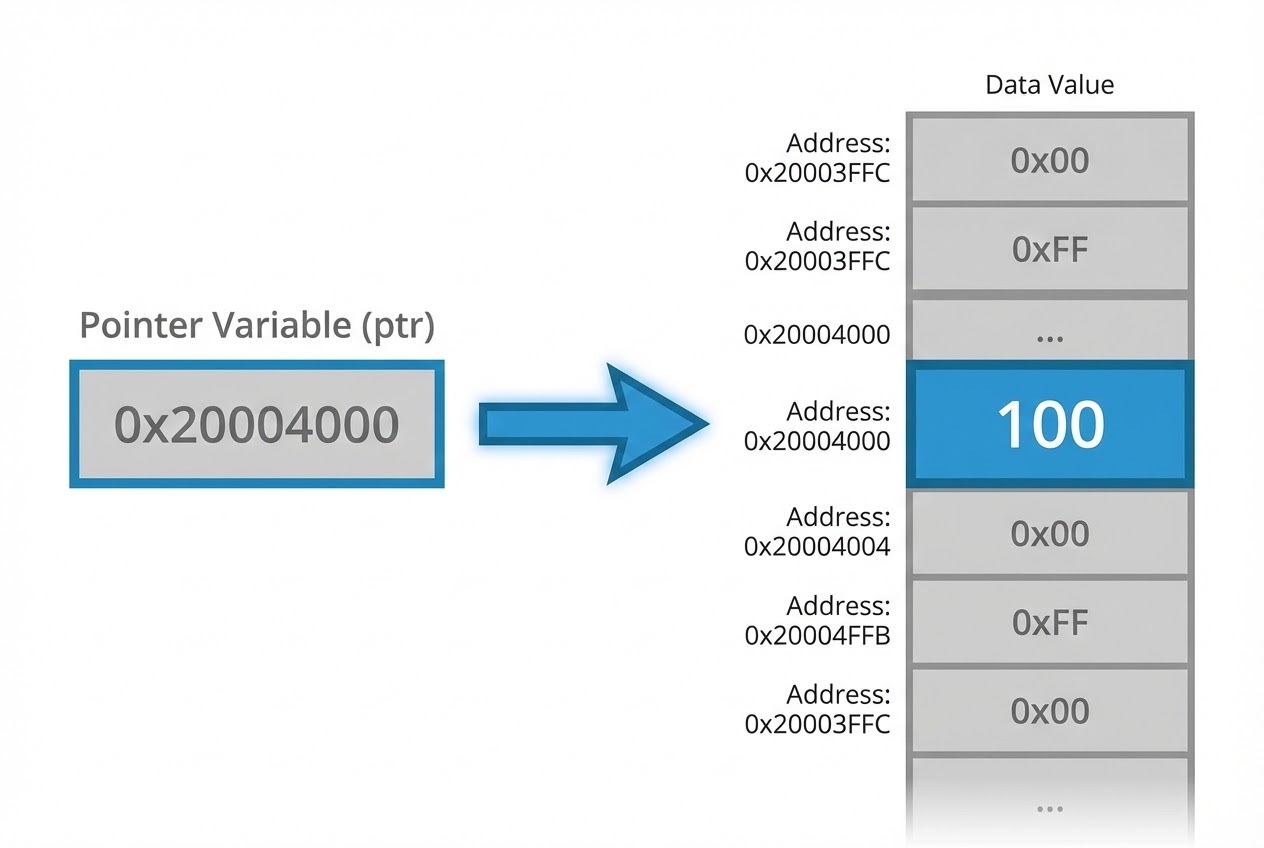
In programming, every variable you declare is stored somewhere in the computer’s Memory (RAM). Each of these memory slots has a unique Address. Think of memory as a massive neighborhood: the Address is the “House Number,” and the Data stored inside is the “Resident.”
So, what exactly is a Pointer? A pointer is simply another type of variable. However, instead of storing a standard number or a character, it stores the Memory Address of another variable. In our analogy, a pointer is a piece of paper where you wrote down someone else’s house number.
When working with pointers, we primarily use two core operators:
- Address-of Operator (
&): Used to “ask for the address.” When you place&in front of a variable, it returns that variable’s memory address so you can store it in a pointer. - Dereference / Indirection Operator (
*): Used to “access the destination data.” When you already have a pointer storing an address, placing a*in front of the pointer means “go to that address and read or modify the data residing there.”
Pointer Arithmetic
The absolute brilliance of pointers in C is that they are type-aware. When you add 1 to a pointer (pointer + 1), it doesn’t just increment the raw memory address by 1 byte. Instead, it jumps forward by the exact size of its Data Type.
For example, if a pointer points to a 32-bit integer (int32_t, which is 4 bytes wide), executing pointer + 1 automatically increments the memory address by 4 bytes. This feature is incredibly powerful for iterating through Arrays.
Why is Hardware Programming Impossible Without Pointers?
- Call by Reference: By default, C passes arguments by value (making a copy). If we want a function to modify the original variable, we must pass its Address (a pointer) to the function instead.
- Dynamic Memory Allocation: When allocating memory on the Heap (using
malloc()orfree()), the system returns a pointer to the newly reserved memory block. - Hardware Access: In microcontrollers, we can create a pointer and manually assign it the hardcoded memory address of a hardware peripheral register (e.g.,
0x40021000) to directly toggle LEDs or read sensors!
Code Example: Swapping and Arithmetic
Let’s look at a clean, modern C code example demonstrating Call by Reference (swapping values) and Pointer Arithmetic traversing an array.
#include <stdio.h>
#include <stdint.h>

/* Function to swap values using Pointers (Call by Reference) */
void swap_values(int32_t *ptr_a, int32_t *ptr_b) {
    int32_t temp;
    temp = *ptr_a;      /* Read the value at the address ptr_a points to, store in temp */
    *ptr_a = *ptr_b;    /* Take the value from ptr_b's address and overwrite ptr_a's address */
    *ptr_b = temp;      /* Write the saved temp value into ptr_b's address */
}

int main(void) {
    int32_t num1 = 100;
    int32_t num2 = 200;

    printf("Before Swap: num1 = %d, num2 = %d\n", num1, num2);

    /* Pass the Addresses of num1 and num2 to the function */
    swap_values(&num1, &num2);

    printf("After Swap : num1 = %d, num2 = %d\n", num1, num2);

    /* ================================================== */
    /* Example: Pointer Arithmetic with an Array          */
    /* ================================================== */
    int32_t sensor_data[] = {10, 20, 30};
    int32_t *ptr_sensor = sensor_data; /* Points to the first element (Index 0) */

    printf("\nPointer Arithmetic:\n");

    /* Notice how ptr_sensor++ increments the address by 4 bytes automatically */
    printf("Value 1: %d\n", *ptr_sensor);

    ptr_sensor++; /* Move the pointer to the next element in the array */
    printf("Value 2: %d\n", *ptr_sensor);

    return 0;
}
Best Practices & Hidden Dangers
While pointers are immensely powerful, C gives you the freedom to shoot yourself in the foot. If you misuse them, the system will instantly crash! Expert firmware engineers follow these strict guidelines:
- Beware of Wild Pointers: When you declare a pointer without assigning it an address, it holds random garbage memory and points to an unknown location. Dereferencing a wild pointer causes erratic bugs, memory corruption, or a Segmentation Fault.
- Always Initialize to
NULL: If you create a pointer but don’t have a valid address for it yet, immediately set it toNULL(or0). This acts as a flag meaning “this points to nothing.” Always useif (ptr != NULL)before dereferencing to prevent catastrophic crashes. - Dangling Pointers: This nightmare occurs when a pointer still points to a memory location that has already been deallocated (like after calling
free(), or returning a pointer to a local variable that has been popped off the Stack). Accessing it is a critical error. Rule of thumb: immediately set pointers toNULLafter freeing them. - Never Subtract Unrelated Pointers: Pointer arithmetic should only be used to navigate within the same array. Subtracting two pointers that point to completely different arrays (trying to find the distance between them) is Undefined Behavior, as compilers can arbitrarily space arrays out in physical memory.
Conclusion
Pointers are simply variables that store memory addresses, granting us the ultimate flexibility to directly access, manipulate, and traverse computer memory. They are the master key to dynamic memory allocation and bare-metal hardware control. Yes, they bring the risk of Memory Leaks and Segmentation Faults if mishandled, but when written carefully and following best practices, they become the C developer’s most powerful weapon.
Are you currently struggling with passing pointers to functions, trying to build your first Linked List from scratch, or wondering how Function Pointers actually work? Don’t keep those questions to yourself! Drop your code and join the discussion on our community board at www.123microcontroller.com. See you in the next article. Happy Coding!