Address-of Operator (&): Unlocking Memory Locations in C

Address-of Operator (&): Unlocking Memory Locations
Hello embedded engineers and developers of the 123microcontroller community! Welcome back to another technical deep dive with your favorite sleep-deprived engineer.
When we start writing code in C, interacting with memory is completely unavoidable. Imagine a microcontroller’s RAM as a massive “village” with houses lined up in a long row. When we create a variable, it’s like building a house to store our data. But here is the question: If we want someone else (like a Pointer or a Function) to visit that specific house, how do we give them directions?
The answer is simple: We need the “House Number” (Memory Address)! In the C programming universe, the ultimate tool to extract that house number is the Address-of Operator (&). Today, we are going to dissect the mechanics of the & operator and see exactly how it acts as the primary key to mastering pointers. Let’s dive in!
The Mechanics of Referencing
At the fundamental level of memory management, expert software architects explain the principles of the Address-of Operator (&) as follows:
1. The Unary Extraction Tool
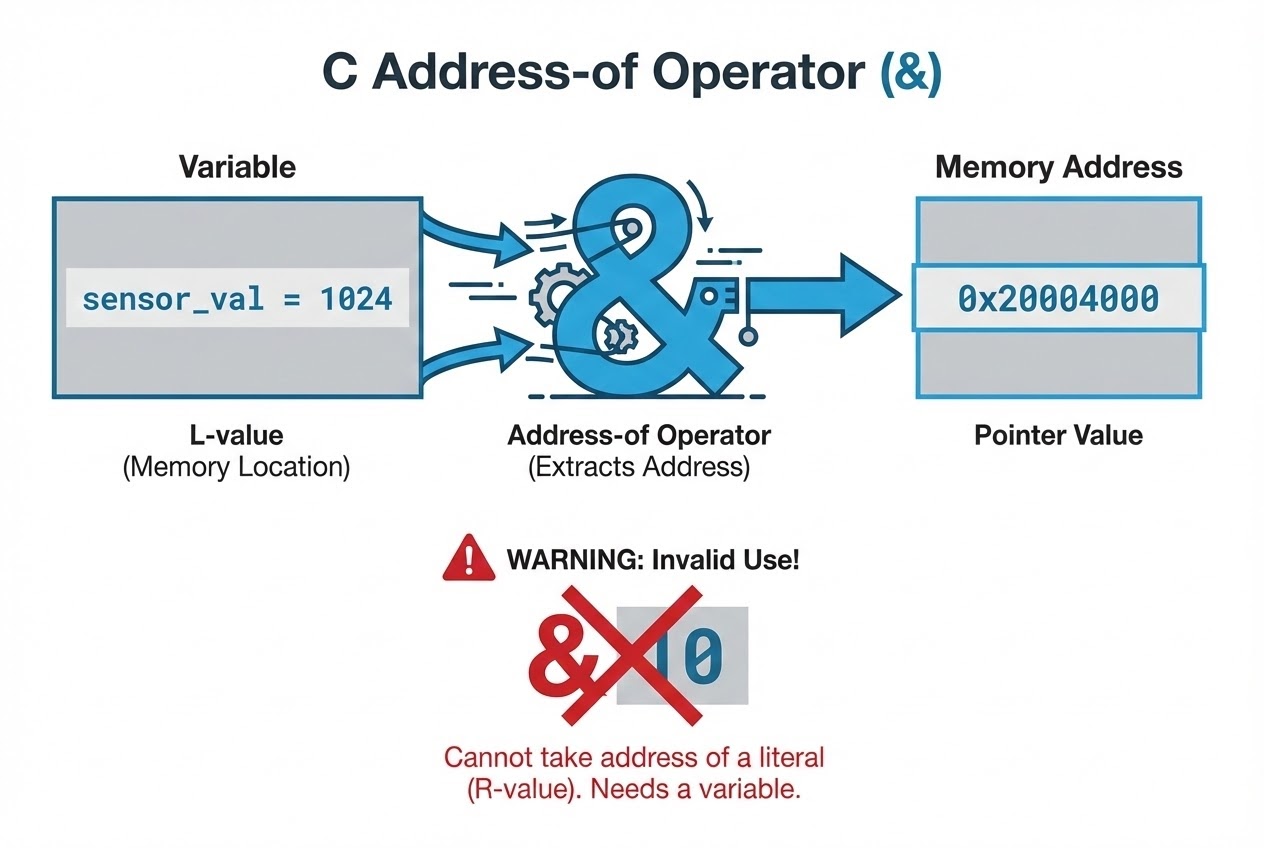
The & symbol is a Unary Operator (it operates on a single operand). When placed immediately in front of a variable (e.g., &var_int), it does not return the variable’s data. Instead, it extracts and returns the Memory Address where that variable lives, allowing us to pass that location around our program.
2. The Birth of a Pointer
By definition, a Pointer is a variable designed to store an address. However, when you declare a pointer, it starts off pointing to absolute garbage. We must use the & operator to extract a valid target’s address and use it to initialize the pointer. For example: pi = #.
3. R-value Status (Pointer Constant)
Remember the concepts of L-value and R-value? When we evaluate &ch, the result is a “Pointer Constant”—a raw hexadecimal number representing a location. This result is strictly an R-value. You cannot place it on the left side of an assignment operator because an address itself is not a physical storage box that can receive new data. (Executing &ch = 100; is a fatal syntax error).
4. Special Behavior with Arrays
We know that using an array’s name by itself decays into a pointer to its first element. However, if you apply the & operator to an array name (e.g., &vector), the data type changes. It no longer points just to the first integer; it becomes a “Pointer to an array” of that specific size. This distinction is critical when passing multi-dimensional arrays or fixed-size buffers to hardware HAL functions.
Code Example: Clean Address Extraction
Let’s look at a practical, clean C code example showing how to extract addresses for pointers and how to pass them correctly to standard functions like scanf.
#include <stdio.h>
#include <stdint.h>

int main(void) {
    /* 1. Declare a standard variable to hold data */
    int32_t sensor_val = 1024;

    /* 2. Use '&' to extract the address and store it in a Pointer */
    int32_t *ptr_sensor = &sensor_val;

    /* Use %p and cast to (void*) to safely print Memory Addresses */
    printf("Value of sensor_val: %d\n", sensor_val);
    printf("Address of sensor_val (&sensor_val): %p\n", (void*)&sensor_val);
    printf("Value stored in ptr_sensor: %p\n", (void*)ptr_sensor);

    /* =========================================================
     * 3. Using '&' with the scanf function
     * ========================================================= */
    int32_t user_input;
    printf("\nEnter a new sensor threshold: ");

    /*
     * 🛡️ scanf requires an "Address" so it knows exactly WHERE in memory
     * to write the keyboard input. Therefore, '&' is absolutely mandatory!
     */
    if (scanf("%d", &user_input) == 1) {
        printf("You entered: %d\n", user_input);
    }

    return 0;
}
Best Practices & Hidden Traps
Using the & operator seems incredibly straightforward, but it is the source of some of the most infamous bugs in C programming history. Secure coding standards warn against these traps:
- Forgetting
&inscanf(The Immortal Bug): Because C uses “Pass by Value” (sending a copy of the data),scanfcannot modify your variable unless you give it the variable’s physical address. If you forget the&(e.g., typingscanf("%d", user_input);),scanfreads the value inside the variable (which might be0or random garbage) and mistakenly treats that number as a Memory Address! When it tries to write the user’s input into that bogus address, your program will instantly suffer a Segmentation Fault and crash. - Using
&with Constants or Expressions: You can never write something like&10or&(x + y). Numbers and math expression results are not L-values; they do not have a dedicated, permanent home in RAM. They exist temporarily in the CPU’s registers. The&operator strictly requires a tangible variable with a real memory location. - Type Mismatch Danger: If you have
char c;, evaluating&cyields achar *(pointer to a 1-byte char). You must never force this into an incompatible pointer type, likeint32_t *pi = (int32_t*)&c;. If you dereferencepilater, the CPU will attempt to read or write 4 bytes, blowing right past the boundaries of your 1-bytecharand corrupting adjacent memory!
Conclusion
The Address-of Operator (&) is the starting point of the entire Pointer universe. It is the specialized tool that translates a human-readable “Variable Name” into a machine-level “Memory Coordinate.” Mastering it allows us to initialize pointers and safely pass memory locations to functions, granting us unparalleled efficiency in manipulating data.
Has anyone here ever triggered a Blue Screen or a mysterious system reset simply because they forgot a single & in scanf? (I guarantee every C programmer has been hazed by this bug at least once! 😂) Don’t forget to drop by and share your funniest debugging stories on our community board at www.123microcontroller.com! See you in the next article. Happy Coding!